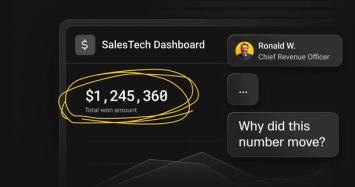
For the better part of three decades, enterprise software evolved around a simple promise: if organizations could collect enough information, move it efficiently between systems, and surface it cleanly enough inside dashboards and reporting layers, then better decisions would emerge almost automatically. Databases would remember for us. Dashboards would reveal truths previously hidden in the fogbanks of corporate entropy. If enough information could be collected, normalized, indexed, and rendered into tasteful pie charts, then understanding itself might finally become industrialized.
And yet the central burden never really disappeared. Someone still had to make sense of it all.
The modern enterprise now produces information continuously, almost atmospherically. Every customer interaction leaves a trace. Every workflow generates metadata. Reports circulate through inboxes and meetings. Alerts appear and notifications accumulate. Context fragments and redistributes itself across systems faster than any individual employee can fully absorb.
Organizations became more data-driven. They also became more cognitively demanding.
This is the contradiction many companies now find themselves living inside. Never before have businesses possessed so much visibility into their operations, yet employees still spend enormous amounts of time gathering context before meaningful action can happen. The information exists. The difficulty lies in assembling coherence from the accumulation.
Most AI Still Lives Outside the Operational Core
The recent rise of AI assistants and copilots to delve into this data has introduced a new kind of interface — one that feels more immediate, conversational, almost ambient. But many current implementations still exist slightly outside the operational core of the business itself. Information is exported into external environments. Context is synchronized into vector databases. Summaries are generated from systems that remain disconnected from the live state of the organization.
These approaches can be useful. They can reduce friction around access and retrieval. But summarization alone is not operational understanding.
Understanding requires proximity to the movement of the business itself: customer behavior, workflow pressure, support history, operational drift, financial changes, organizational priorities. The enterprise behaves less like a static database than a living system, continuously generating new context as it moves through time.
This is why AI increasingly feels less like a feature and more like a structural transition.
The Shift Is Happening Inside the Enterprise Stack
The deeper shift underway is not simply the appearance of chat interfaces layered on top of existing software. It is that enterprise systems themselves are beginning to participate in contextual understanding.
Historically, responsibilities inside enterprise architecture remained cleanly separated. Databases stored information while applications managed workflows. Dashboards surfaced metrics and employees connected the relationships between them. Human judgment remained indispensable because the systems themselves could not meaningfully assemble operational context on their own.
Embedded intelligence changes that arrangement.
As intelligence moves closer to the operational and data layers, enterprise platforms become increasingly capable of identifying relationships across transactions, customer interactions, support activity, operational metrics, and organizational behavior in real time. Instead of requiring employees to manually gather fragments of information across multiple environments, intelligence-native systems can begin assembling relevant context automatically and surfacing explanations directly within the workflow itself.
Not replacing human judgment but reducing the friction surrounding it.
This distinction matters because most organizations are not constrained by a lack of information. They are constrained by the speed at which information becomes usable understanding.
Intelligence Is Becoming a Foundational Enterprise Capability
Most discussions about AI still frame it as a productivity tool, an automation layer, or an application feature. Those descriptions capture part of the transition, but they underestimate its architectural significance.
What is emerging is a new enterprise layer centered on operational understanding itself: the Intelligence Layer.
Infrastructure allowed software to scale, databases allowed information to persist and applications digitized workflows. The intelligence layer helps organizations continuously interpret the growing complexity of their own operations while those operations are actively unfolding.
The important question is no longer whether AI will influence enterprise software. That question has already been answered. The more important question is how intelligence will integrate into the systems employees already rely on every day.
Will organizations continue asking employees to manually bridge fragmented systems and reconcile operational complexity on their own? Or will enterprise platforms increasingly help assemble context, surface understanding, and accelerate decision-making directly within the flow of work itself?
Because the companies that solve this problem will not merely move faster. They will think faster.
And in the coming decade, that difference may become indistinguishable from power.