

SingleStore vs. SAP HANA
SAP HANA is the in-memory database behind SAP S/4HANA and SAP’s data products. SingleStore is one distributed database for transactions, analytics and search, with data on disk and memory as a cache, for applications and analytics beyond SAP.
Comparison as of November 2026, based on SAP’s website and documentation.
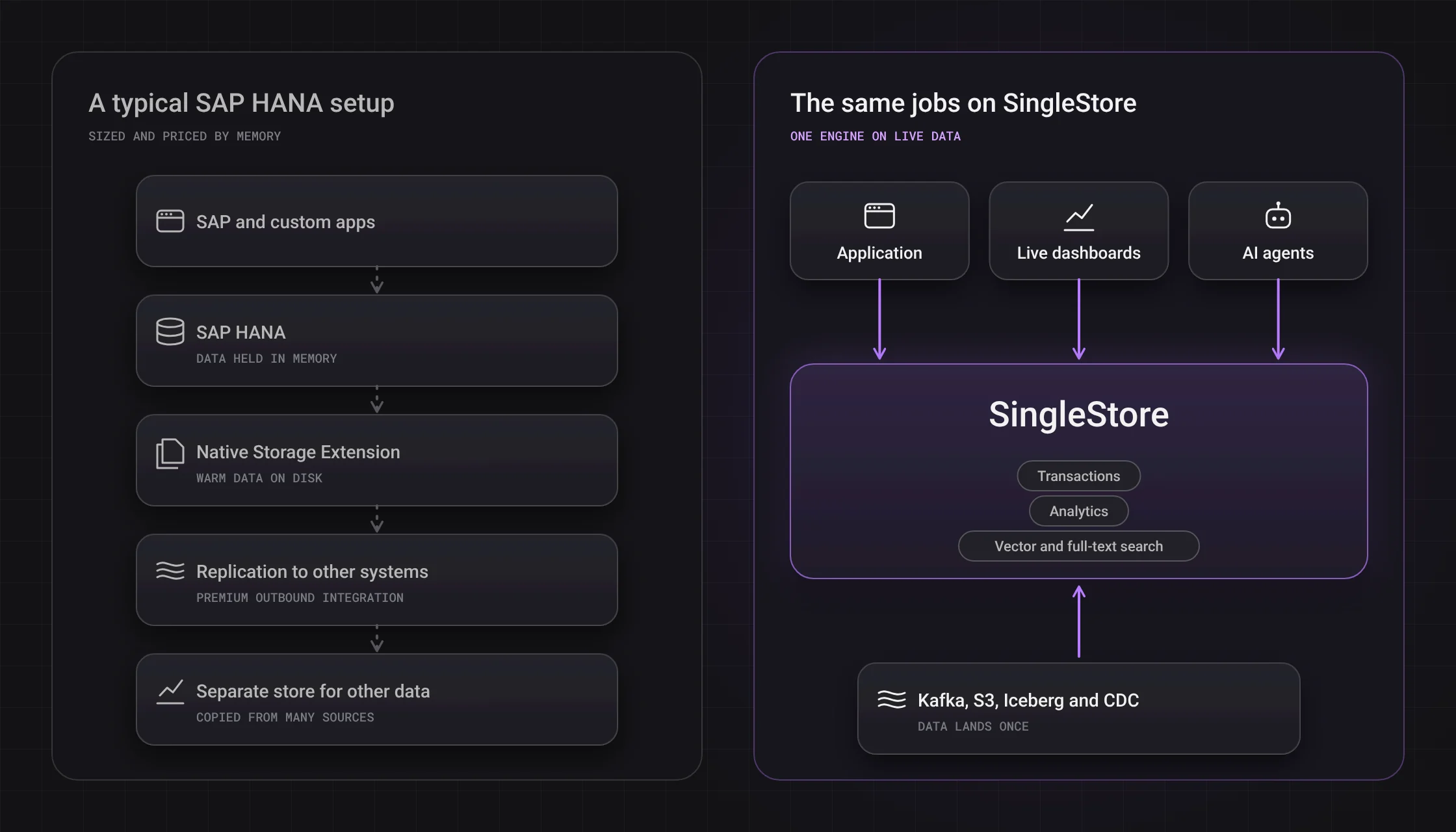
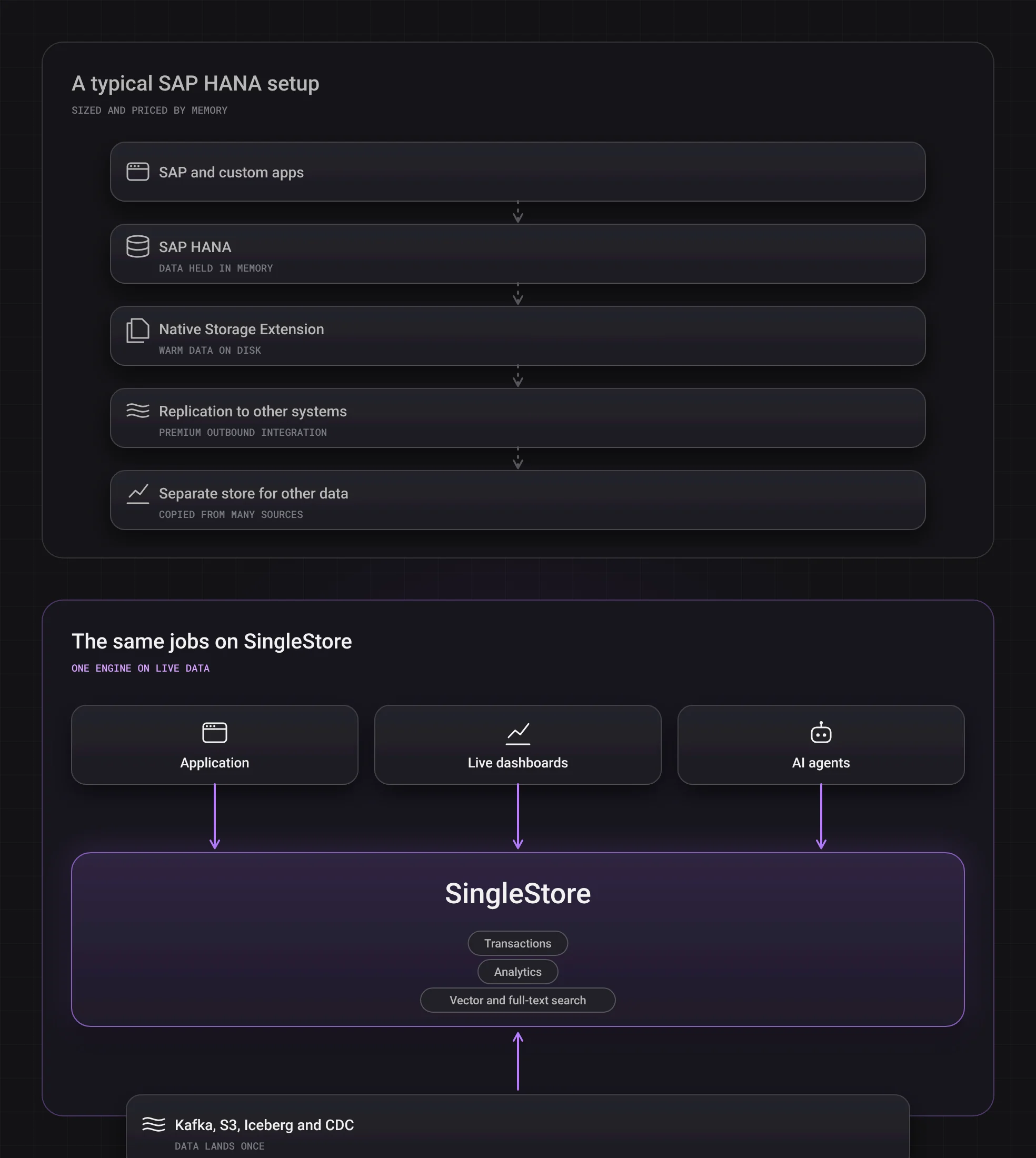
SAP HANA runs SAP’s own applications well. These are the points where applications and analytics beyond SAP run into cost and complexity.
Each SAP HANA entry comes from SAP Help, SAP’s pricing page or posts by SAP staff, listed under Sources at the end of this page.
| Capability | SingleStore | SAP HANA |
|---|---|---|
Core design | One distributed SQL database for transactions, analytics and search, on one copy of the data. See SingleStore Helios. | An in-memory, column-oriented database, the foundation of SAP S/4HANA. Delivered as SAP HANA Cloud, with quarterly releases, and as SAP HANA 2.0 SPS08 on premises. |
Memory and storage | Tables on disk, with hot data cached in memory, so database size isn’t limited by RAM. See Universal Storage. | Data held in memory, sized at 16 GB per vCPU by default, up to about 12 TB per instance on AWS in most regions. Native Storage Extension keeps warm data on disk. |
Scaling | Data and writes are distributed across the nodes of a cluster, with every table sharded automatically. | Scale up within an instance, plus up to 16 read-only elastic compute nodes in SAP HANA Cloud. Permanent scale-out was listed as planned. |
Transactions | ACID transactions with enforced primary and unique keys, on the same tables as the analytics. | Full ACID transactions, proven under SAP’s ERP workloads. A long-standing strength. |
Analytics on live data | A columnstore with vectorized execution on the same tables as the transactions. See query performance. | In-memory columnar analytics on transactional data. A long-standing strength. |
Vector and full-text search | Vector and full-text indexes on the same tables, combined with SQL filters in one query, in every deployment. See hybrid search. | The Vector Engine with HNSW indexes and in-database embeddings in SAP HANA Cloud, plus full-text indexes with fuzzy search. |
SQL and drivers | ANSI SQL over the MySQL wire protocol, so SQL clients, BI tools and MySQL drivers connect directly. | SAP HANA SQL and its own protocol, with JDBC, ODBC, ADO.NET, Python, Node.js and Go clients. |
Data integration | Pipelines load from Kafka, S3 and Apache Iceberg, and partner tools replicate SAP data. | SAP Landscape Transformation, Smart Data Integration and Datasphere replication flows, with premium outbound integration for non-SAP targets. |
Pricing model | Compute billed per hour by cluster size, from $0.99 an hour on Standard, plus storage. A free Shared cluster for development. See pricing. | SAP HANA Cloud is billed in capacity units based on memory, compute and storage, with a free tier of 16 GB. On-premises licenses come from SAP. |
Certifications | ISO 27001 and SOC 2 Type 2. See the Security and Trust Center. | SAP publishes its own certifications. Self-managed deployments depend on the environment you run them in. |
Accurate at the time of publication, November 2026, when SAP HANA Cloud QRC 3/2026 was the latest confirmed release. SAP ships SAP HANA Cloud releases every quarter, so confirm current capabilities, licensing and pricing with SAP and on SAP Help. Sources for each SAP HANA entry are listed at the end of this page. Spotted something out of date? Tell us.
| Where it runs | SingleStore | SAP HANA |
|---|---|---|
Managed cloud service | SingleStore Helios® on AWS, Azure and Google Cloud. | SAP HANA Cloud on AWS, Azure, Google Cloud, Alibaba Cloud and SAP Cloud Infrastructure. |
Your own data center | SingleStore Self-Managed, in single-node or multi-node clusters. | SAP HANA 2.0 on certified appliances or tailored data center integration. |
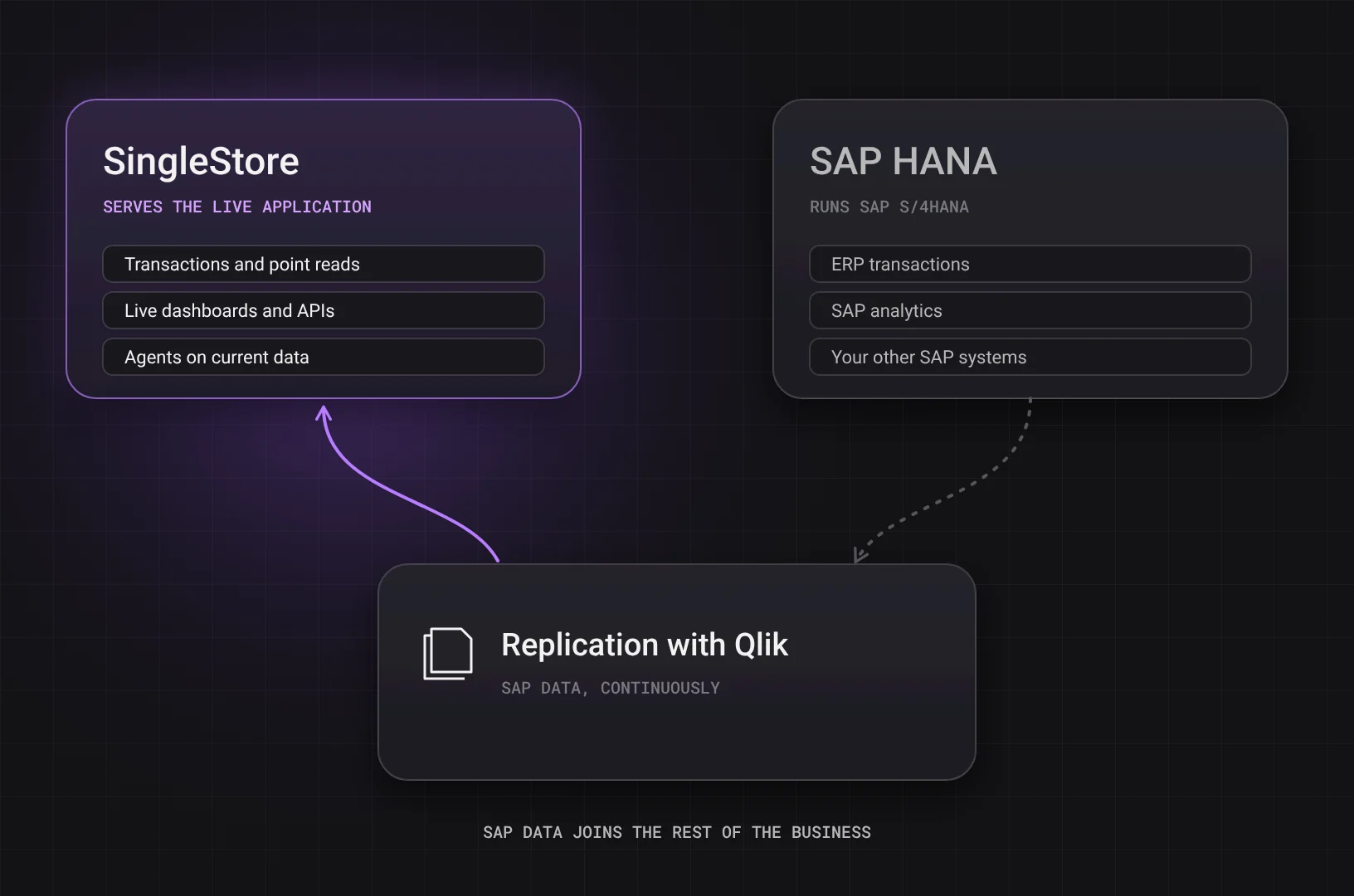
SAP S/4HANA runs only on SAP HANA, so teams keep it there. They add SingleStore for applications and analytics that combine SAP data with the rest of the business.
Partner tools such as Qlik replicate SAP data into SingleStore, and Pipelines load data from Kafka, cloud storage and other databases into the same tables. Check SAP’s terms for the interface you use.
No. SAP S/4HANA runs only on SAP HANA. SingleStore fits next to it, for applications and analytics that combine SAP data with the rest of the business.
Through SAP-supported interfaces and partner tools. SingleStore partners with Qlik for SAP data replication, and Pipelines load whatever lands in Kafka or cloud storage. Check SAP’s terms for the interface you use.
Memory is fast, and SingleStore uses it as a cache over disk. In a head-to-head test at a Fortune 25 bank, SingleStore averaged three times faster than SAP HANA, with more consistent response times. The fair test is your own workload.
Quarterly releases added an agent memory service on the Vector Engine, read-only Apache Iceberg tables and larger instances on AWS (QRC 3/2026). Sizing and pricing still follow memory.
The models differ: SAP HANA Cloud charges by memory-based capacity units, and SingleStore by cluster hour, with data on disk. The fair comparison is your own data size and workload, so talk to an engineer about it.
It reflects both products as of November 2026, when SAP HANA Cloud QRC 3/2026 was the latest confirmed release. Check SAP Help for changes since then, and tell us if something here is out of date.
SAP HANA source documentation: sap.com, SAP HANA Cloud on SAP Help, memory and storage sizes, elastic compute nodes, scale-out plans, premium outbound integration, Vector Engine, Vector Engine and on premises, quarterly releases, SAP HANA 2.0 SPS08, full-text indexes, JDBC, ODBC, ADO.NET, Python, Node.js and Go clients, capacity units, free tier, certified appliances or tailored data center integration, SAP S/4HANA runs only on SAP HANA, QRC 3/2026.

Bring your heaviest SAP HANA query.
See it run on SingleStore.
Talk to an engineer about your workload, or start free on a Shared cluster.