There's a compliment buried in your database problem.
If you're a B2B SaaS company in a regulated industry - insurance, credit, lending, compliance - approaching or past the $100M ARR mark and wrestling with infrastructure limits, you earned that problem. It means you built something real. You shipped fast, iterated relentlessly, and won customers in one of the most demanding verticals in the world. PostgreSQL didn't just tolerate that journey; it enabled it.
But something has shifted. The same architecture that made you fast is now making you slow. Enterprise clients are asking questions your stack can't confidently answer. Your engineers are spending weekends firefighting data pipelines instead of building product. And you can feel, viscerally, that the next tier of growth is right there - if the infrastructure can keep up.
This post is for the CTO, VP of Engineering, or Architect who's already living this - a practical look at what's actually breaking, why it breaks at scale, what a genuinely unified data layer makes possible, and why the window to act is now.
The $100M Ceiling Is a Database Ceiling
For regulated SaaS platforms and fintech applications operating in high-stakes financial verticals - underwriting workflows, credit decisioning, compliance automation, risk management - the day-to-day data demands are intense: thousands of concurrent users, real-time calculations, regulatory reporting, and complex multi-tenant architectures where each client carries significant schema complexity. And increasingly, AI-driven features are expected as standard.
PostgreSQL handles this beautifully - up to a point. That point tends to arrive, predictably, somewhere around the $100M ARR mark.
THE CORE TECHNICAL CONSTRAINT
PostgreSQL is a single-writer system. One primary node accepts all writes. You can read-scale with replicas, but every INSERT, UPDATE, and DELETE funnels through one bottleneck. At high scale - with dozens or hundreds of microservices writing simultaneously across a large tenant base - this becomes a hard ceiling on your ability to onboard new clients.
Even OpenAI - with one of the most sophisticated engineering teams in the world - publicly documented that write requests became their primary PostgreSQL bottleneck at scale, requiring migration of write-heavy workloads to distributed systems. For a funded fintech without that engineering bench, hitting this wall without a plan is a genuine risk.
For a company staring down the opportunity to significantly expand its customer base - perhaps landing a major enterprise client that would meaningfully reshape the business overnight - this isn't theoretical. It's the thing standing between you and that contract.
The "Bolt-On" Trap: How Stacks Get Fragile Fast
The engineering instinct, when PostgreSQL starts creaking, is entirely reasonable: reach for specialized tools. The ecosystem of available options is mature and genuinely capable - the problem isn't any individual tool, it's what happens when you need all of them running together.
A typical pattern at fast-growing fintechs looks like this: PostgreSQL handles transactional writes. A columnar analytics engine - ClickHouse, Apache Druid, Amazon Redshift, or similar - gets added for reporting workloads. An in-house time-series solution handles event and telemetry data. A dedicated vector index is bolted on for AI features. And a synchronization layer of ETL jobs, CDC pipelines, or managed connectors is wired between all of them to keep the data in sync.
Each of these tools is good at what it was designed for. ClickHouse is a genuinely fast analytical engine - but by its own design, it is a pure OLAP system with no full ACID compliance and asynchronous row-level mutations. Apache Druid is optimized for time-series and event data but struggles with complex joins. Redshift introduces its own ingestion latency and operational overhead. None of these were designed to be a system of record. They can only ever be downstream consumers of PostgreSQL data - which means every one of them needs that synchronization layer.
When a synchronization pipeline breaks before a client deliverable, your best engineers aren't building features - they're incident-managing infrastructure. Every one of these tool additions was the right call at the time. Together, they create compounding operational debt and a distributed system that fails in unexpected ways.
What the Architecture Actually Needs to Look Like
If you step back from the patchwork and ask what a data layer needs to do to support a regulated SaaS company from $100M ARR through $500M and beyond, the requirements become clear:
- Distributed writes and horizontal scaling so that adding clients doesn't mean adding write bottlenecks
- Transactions,analytics, and financial data processing on the same data without a synchronization layer between them, and without analytical queries degrading transactional performance
- Native support for vectors and full-text search so AI features are first-class citizens, not bolt-ons that go stale
- Compliance-ready and built for high availability by default SOC 2, HIPAA, ACID - embedded in the architecture, not added on later
- Elastic multi-tenancy the ability to onboard large new clients without re-architecting the entire deployment
- Predictable operational overhead so engineers are building product, not maintaining pipelines
That's a precise specification - and it's one that's difficult to satisfy with a stack of specialized tools, because each tool solves one part of it while creating friction against the others. What it describes, structurally, is an HTAP system: one that handles both transactional and analytical workloads natively, without the need for a separate analytical store.
This is the architectural direction the industry has been converging on. A 2024 industry analysis on HTAP systems identifies the synchronization tension between transactional and analytical workloads as a fundamental constraint in bolt-on architectures - one that can be managed but not eliminated without a unified engine. Both Snowflake and Databricks independently reached the same conclusion in 2025, each acquiring a PostgreSQL-native company rather than continuing to extend their analytical engines into transactional territory.
WHERE SINGLESTORE FITS
SingleStore is an HTAP database built for exactly this specification. It combines a rowstore (optimized for transactional reads and writes) with a columnstore (optimized for analytical scans) in a single Universal Storage format - meaning transactions and analytics run on the same data, in the same engine, with no ETL between them. Vector search, full-text search, and time-series queries are native capabilities. The result is the architecture described above, without the synchronization layer.
See the SingleStore vs. PostgreSQL comparison and real-time analytics overview for technical detail on how the architecture works in practice.
What Enterprises Expect That Your Stack Isn't Ready For
When you're selling to mid-market clients, you can work around architectural limitations. Larger deals close over longer cycles; there's room to iterate. But when you're in the room with a global enterprise - a major insurer, a tier-1 financial institution, a large government contractor - the conversation changes. These organizations have entire teams dedicated to evaluating vendor infrastructure.
- Compliance and security architecture. HIPAA, SOC 2, ACID compliance - not as checkbox items, but as architectural capabilities. "We'll add that layer" isn't an answer they accept. They want it embedded, not bolted on.
- Disaster recovery and SLAs. RTO, RPO, per-second point-in-time recovery, regional failover - these are table-stakes in enterprise procurement. SingleStore's Smart DR uses compute/storage separation so you get a second region for resilience without paying double for compute.
- Data isolation and multi-tenancy. The ability to branch, snapshot, and isolate data - without standing up duplicate infrastructure - is an operational requirement. SingleStore's workspace model lets you spin up isolated environments for new clients instantly.
- AI and agent readiness. Enterprise clients in 2026 aren't asking whether you support AI. They're asking about latency at scale for concurrent agent workloads. Vector search, hybrid search, and real-time feature generation need to live in the same system as your transactional data - not in a separately managed index with its own synchronization lag.
A Fortune 25 financial institution chose SingleStore over SAP HANA for its equities trading platform for exactly these reasons - OLTP, OLAP, and vector workloads in a single system. Read the full case study. For financial services capabilities in detail, see the SingleStore Financial Services page.
The worst outcome in enterprise sales isn't losing to a competitor. It's losing to "we'll build it ourselves" - because your performance didn't clear their bar.
The Migration: What It Actually Involves
Here's where a lot of companies stall. They know they need to move. They don't start because the migration feels impossibly large. Let's be direct about what it actually involves.
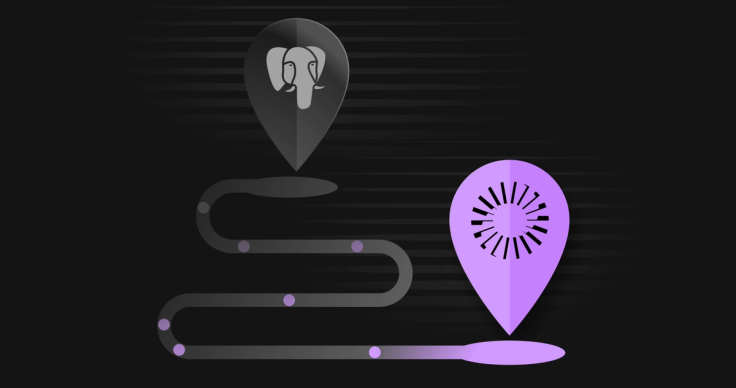
SingleStore is PostgreSQL-compatible at the query level - most queries run without modification. The complexity is in the migration process itself, not the destination. A typical regulated SaaS platform might have hundreds of microservices, each with its own PostgreSQL schema, different query patterns, SLAs, and data volumes. The right approach is service-by-service, schema-by-schema - not a big-bang cutover.
- Audit each microservice in isolation. What are the query patterns, expected SLAs, and write volumes? Profile each service rather than assume compatibility.
- Validate on representative data. Before touching production, replicate your data model and run real workloads against it in SingleStore. Look for latency improvements and edge cases.
- Migrate incrementally with parallel running. Run old and new systems in parallel for a defined window, with automated validation that outputs match. Slower, but it protects you from surprises.
- Use managed ingestion for data movement. SingleStore's native Pipelines support direct ingestion from S3, Kafka, Azure Blob, and HDFS. For no-code schema migration and ongoing CDC, SingleStore Flow handles the initial transfer and change capture.
For technical detail on migration tooling, see the migration documentation and SingleStore Flow docs. Most teams complete initial migrations in weeks, not months.
The Migration Is About to Get a Lot Easier
One of the most consistent things we hear from engineering leaders is: "We know we need to do it. We're nervous about the scale of it." That's an understandable concern - and it's one we take seriously.
SingleStore is actively developing AI-assisted migration capabilities that will fundamentally change the effort involved in moving from PostgreSQL. We want to be transparent about what's coming, because it should factor into your planning.
COMING SOON: AI-ASSISTED MIGRATION
Within the next 6–9 months, SingleStore will deliver tooling that:
- Ingests your PostgreSQL schema automatically and maps it to SingleStore's storage model
- Generates a migration plan with compatibility risks flagged
- Suggests optimal shard keys and sort keys for your specific workload patterns
- Handles bulk data movement without requiring custom scripts or bespoke ETL
This isn't a feature tweak. It turns a weeks-long engineering project into a guided, largely automated process. We're telling you this now not as a reason to wait - but as confidence that the path forward gets easier.
More importantly: we want you to talk to us now, before you've hit the ceiling, so we can scope your specific architecture and walk through what the migration looks like for your stack. The conversations that go best are the ones that start early - when there's still runway to be methodical.
Customers migrating from PostgreSQL to SingleStore report 20–100x query performance improvements on analytical workloads in production environments. That performance headroom is what gives you the confidence to sign the next enterprise client without architectural anxiety.
The Bottom Line
If you're a fast-growing company in a regulated industry running on PostgreSQL and starting to feel the friction, here's the honest picture:
- PostgreSQL's single-writer architecture creates a hard ceiling on write throughput and limits horizontal scaling, directly constraining client onboarding capacity
- Bolt-on analytical tools solve individual problems while creating systemic synchronization overhead - the issue isn't any one tool, it's the compounding cost of running many
- Enterprise clients at the global level expect compliance, DR, and AI-readiness as architectural defaults - not afterthoughts
- What's needed is a unified HTAP layer one that handles transactions, analytics, vector search, and compliance natively - and that's where SingleStore fits
- The migration is manageable now and becomes significantly easier with AI-assisted tooling arriving in the next 6–9 months
- The window to act is open waiting until the ceiling is hit leaves fewer options and considerably more risk
READY TO EXPLORE WHAT THIS LOOKS LIKE FOR YOUR STACK?
SingleStore's solutions engineering team works directly with fintech engineering teams to evaluate current architectures, identify specific bottlenecks, and plan migrations that don't disrupt production. The conversation is free and there's no obligation - just clarity on what the path looks like for your specific situation.
Reach out at singlestore.com/contact to talk to a solutions engineer.