

SingleStore vs. Oracle
Oracle Database is a deep, mature database that runs many of the world’s critical systems. SingleStore is one distributed database for transactions, analytics and search, priced per cluster hour, for real-time workloads that Oracle makes expensive.
Comparison as of November 2026, based on Oracle’s website and documentation.
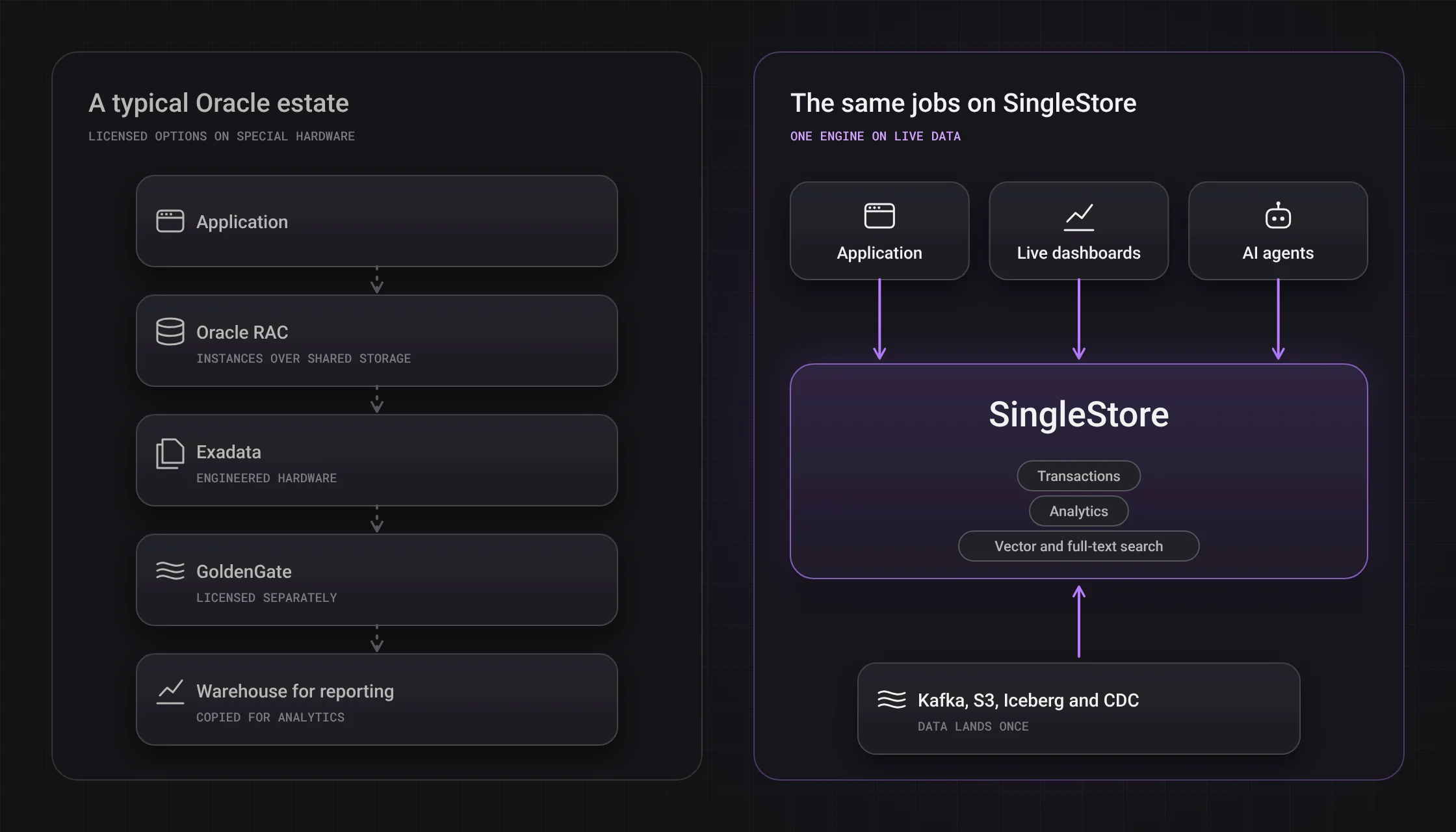
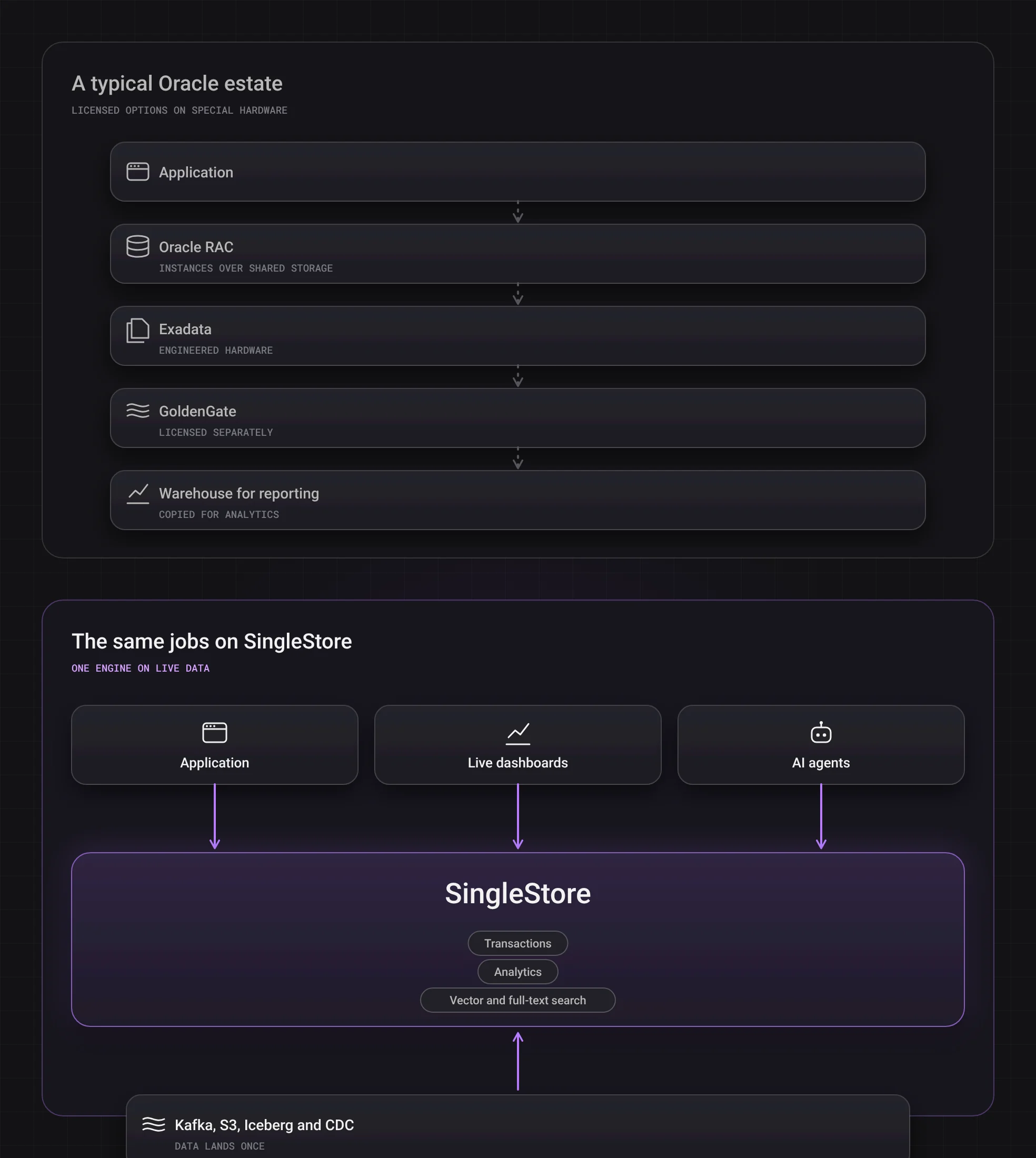
Oracle runs critical transaction systems reliably for decades. These are the points where real-time analytics, scale and AI features run into cost and complexity.
Each Oracle entry comes from Oracle’s documentation, price list or announcements, listed under Sources at the end of this page.
| Capability | SingleStore | Oracle |
|---|---|---|
Core design | One distributed SQL database for transactions, analytics and search, on one copy of the data. See SingleStore Helios. | A multi-model relational database. Oracle AI Database 26ai is the current long-term support release, on premises since January 2026. |
Scaling | Data and writes are distributed across the nodes of a cluster, with every table sharded automatically. | Real Application Clusters scale compute over shared storage, an extra-cost option. Globally Distributed Database shards data, limited to three primary shards without further licenses. |
Transactions | ACID transactions with enforced primary and unique keys. See Universal Storage. | Full ACID transactions, hardened over decades of production use. A long-standing strength. |
Analytics on live data | A columnstore with vectorized execution on the same tables as the transactions. See query performance. | Row storage, with Database In-Memory, an extra-cost columnar option, free up to 16 GB. Exadata adds smart scans in storage. |
Availability and read scale | Replicas within the cluster and high availability in every production deployment, for thousands of concurrent users. | RAC and Active Data Guard for availability and read scale-out, each licensed separately. |
Vector and full-text search | Vector and full-text indexes on the same tables, combined with SQL filters in one query. See hybrid search. | AI Vector Search with HNSW and IVF indexes, included at no extra charge, and Oracle Text for full-text search, with hybrid vector indexes combining the two. A strength. |
SQL and drivers | ANSI SQL over the MySQL wire protocol, so SQL clients, BI tools and MySQL drivers connect directly. | Oracle SQL and PL/SQL, with JDBC, ODBC and Oracle Call Interface drivers. Moving PL/SQL to another database means rewriting it. |
Change data capture | SingleStore Flow replicates from Oracle and Oracle RAC, with a one-time load and ongoing log-based change data capture. | GoldenGate, licensed separately, and the free Zero Downtime Migration tool for moves between Oracle databases. |
Pricing model | Compute billed per hour by cluster size, from $0.99 an hour on Standard, plus storage. A free Shared cluster for development. See pricing. | Enterprise Edition lists at $47,500 per processor plus 22% a year for support, before options. Autonomous AI Database is billed per ECPU hour. |
Certifications | ISO 27001 and SOC 2 Type 2. See the Security and Trust Center. | Oracle Cloud publishes its own certifications. Self-managed deployments depend on the environment you run them in. |
Accurate at the time of publication, November 2026, when Oracle AI Database 26ai was the current release. Prices are Oracle list prices from its published price list, before discounts. Confirm current capabilities, licensing and pricing with Oracle and in the Oracle documentation. Sources for each Oracle entry are listed at the end of this page. Spotted something out of date? Tell us.
| Where it runs | SingleStore | Oracle |
|---|---|---|
Managed cloud service | SingleStore Helios® on AWS, Azure and Google Cloud. | Autonomous AI Database and Exadata Database Service in OCI, and Oracle Database@AWS, Oracle Database@Azure and Oracle Database@Google Cloud inside those clouds. |
Your own data center | SingleStore Self-Managed, in single-node or multi-node clusters. | On your own servers, on Exadata, or on Exadata Cloud@Customer, Oracle-managed hardware in your data center. |
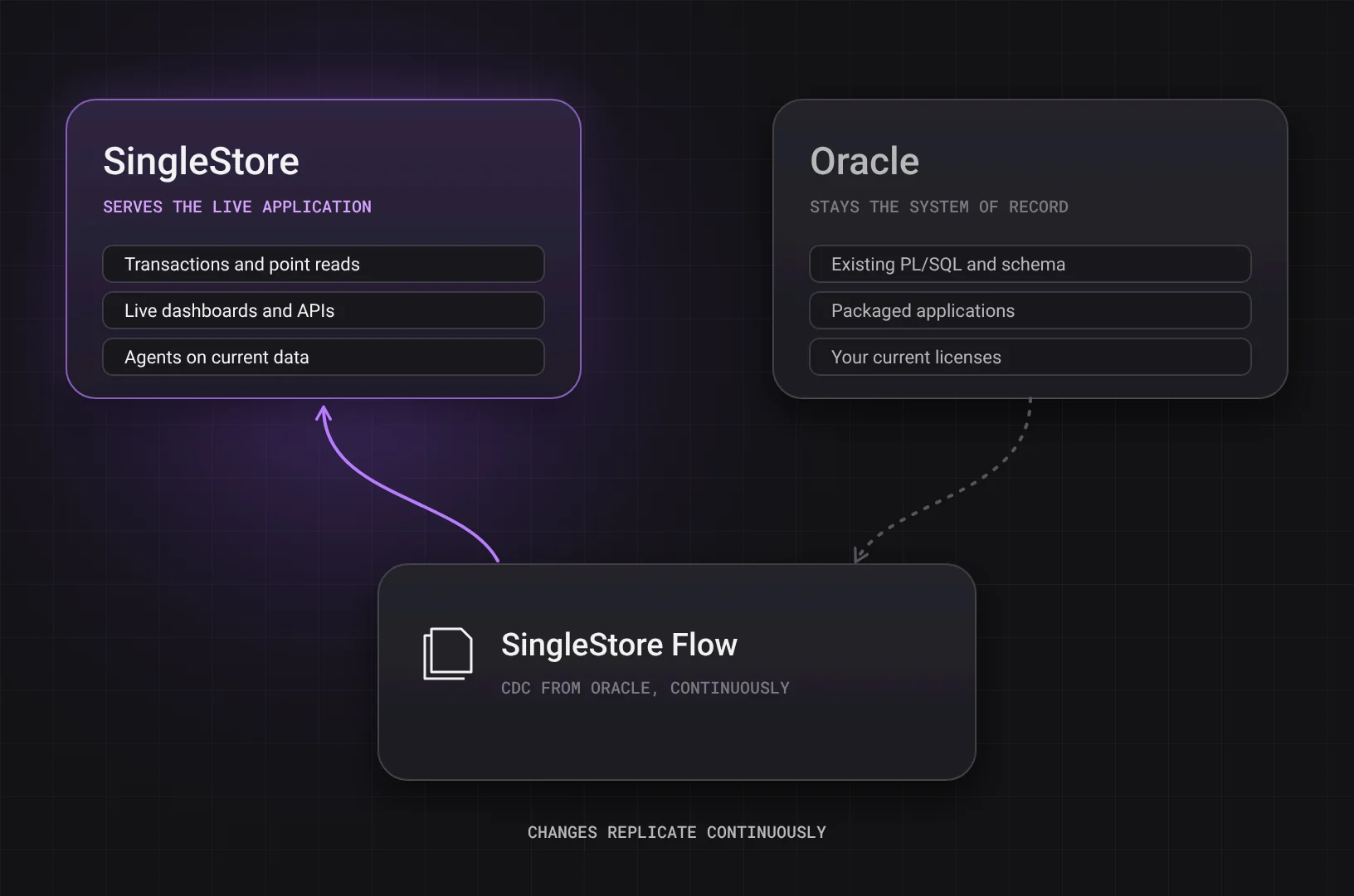
Most teams don’t replace Oracle in one step. They keep it as the system of record and move the workloads that are slow or expensive there first: real-time analytics, reporting and AI features.
SingleStore Flow loads existing Oracle tables in parallel, then replicates changes from Oracle or Oracle RAC through log-based change data capture. Each workload moves to SingleStore when it’s ready.
Not as written. SingleStore has its own procedural SQL, so PL/SQL procedures need rewriting. Most teams start by replicating Oracle into SingleStore with SingleStore Flow and moving analytics and real-time workloads first, which needs no PL/SQL changes.
Yes. SingleStore Flow replicates changes from Oracle and Oracle RAC into SingleStore, so analytics and real-time features run on SingleStore while Oracle stays the system of record.
It speeds up analytics with a columnar copy of tables in memory, an extra-cost option beyond 16 GB. SingleStore’s columnstore is part of every cluster, scales out across nodes and keeps data on disk with memory caching.
It adds features, including AI Vector Search at no extra charge, JSON Relational Duality Views and SQL property graphs (what’s new). The licensing model is the same: options such as RAC and Database In-Memory are still priced separately.
Customers that moved report large savings, such as $5.4 million a year at a top-10 communications provider. The fair comparison is your own workload and license position, so talk to an engineer about it.
It reflects both products as of November 2026, when Oracle AI Database 26ai was the current release, with list prices from Oracle’s published price list. Check with Oracle for changes since then, and tell us if something here is out of date.
Oracle source documentation: oracle.com, Oracle documentation, Technology Global Price List, licensing basics, 26ai licensing information, Database In-Memory base level, Exadata Cloud@Customer, Oracle Database@AWS, Oracle AI Database 26ai, on premises, AI Vector Search, Zero Downtime Migration, Autonomous AI Database, Oracle Database@Azure, what’s new.

Bring your slowest Oracle report.
See it run on SingleStore.
Talk to an engineer about your workload, or start free on a Shared cluster.