

SingleStore vs. ClickHouse
ClickHouse is a fast, open-source columnar database for analytics on large volumes of event data. SingleStore is one database for transactions, analytics and search, so the same tables take updates, joins and point reads as well as scans.
Comparison as of November 2026, based on ClickHouse’s website and documentation.
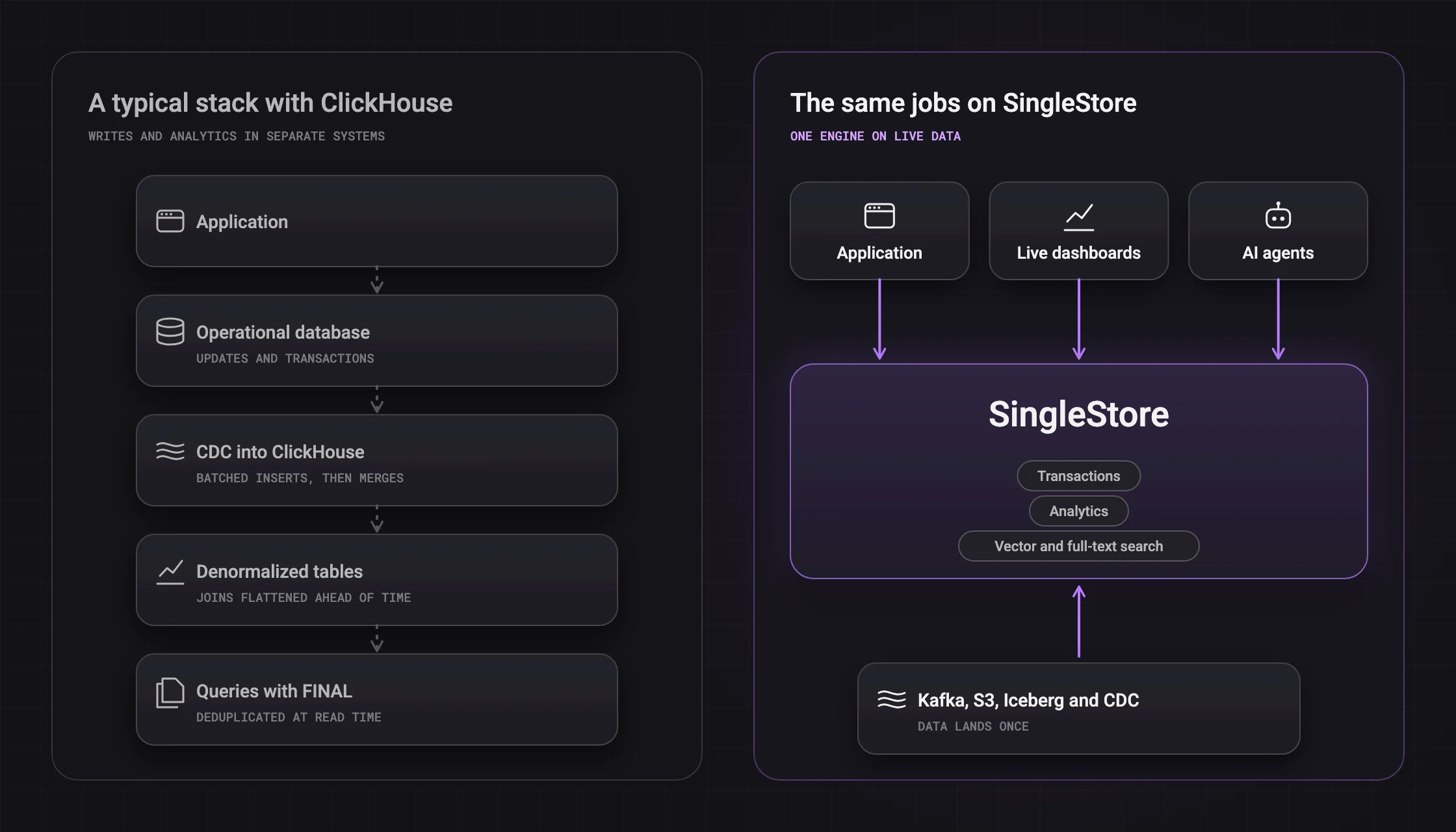
ClickHouse is very fast at scanning large tables of events that rarely change. These are the points where teams asking it to run application data, with updates, joins and transactions, run into trouble.
Each ClickHouse entry comes from ClickHouse’s own documentation, listed under Sources at the end of this page.
| Capability | SingleStore | ClickHouse |
|---|---|---|
Core design | One distributed SQL database for transactions, analytics and search, on one copy of the data. See SingleStore Helios. | A columnar analytical database built on MergeTree table engines, open source under Apache 2.0, with ClickHouse Cloud as the managed service. |
Transactions | ACID transactions with enforced primary and unique keys. See Universal Storage. | Multi-statement transactions are experimental and not supported in ClickHouse Cloud. Primary keys are sparse indexes and don’t enforce uniqueness. |
Updates and upserts | Standard INSERT, UPDATE, DELETE and upserts on any table, visible to every read on commit. See the ACID tests. | UPDATE GA since 26.10, for up to about 10% of a table and not on key columns. ReplacingMergeTree deduplicates at merge time, so reads need FINAL. |
Joins | The optimizer reorders joins automatically, so BI tools query normalized, star and snowflake schemas directly. See our join benchmark. | Join reordering with statistics on by default since 25.12. The docs still strongly recommend denormalization for latency-sensitive queries. |
Data freshness | Single-row writes are queryable when they commit. SingleStore Pipelines load from Kafka, S3 and Iceberg, with change data capture from MySQL and MongoDB®. | Batched inserts of 10,000 to 100,000 rows recommended, and async inserts are queryable after they flush. ClickPipes load from Kafka, S3 and Postgres, MySQL and MongoDB CDC. |
Concurrency | Point reads, writes and analytical queries in the same engine, for thousands of concurrent users. | No concurrent query limit by default in open source, and 1,000 by default in ClickHouse Cloud (concurrency FAQ). The query cache expires on a timer, not when data changes. |
Vector and full-text search | Vector and full-text indexes on the same tables, combined with SQL filters in one query. See hybrid search and our vector benchmark. | An HNSW vector index, GA since 25.8, and an inverted text index, GA in 2026, without BM25 relevance ranking. |
AI and agents | Agentic Intelligence: Aura Analyst for plain-English questions, AI Functions in SQL and the SingleStore MCP server for agents. | An open-source and a remote MCP server, ClickHouse Agents in public beta, and Langfuse for LLM observability. |
SQL and drivers | ANSI SQL, compatible with the MySQL wire protocol, so MySQL drivers and tools connect. | ClickHouse SQL. A MySQL interface in Cloud that isn’t a drop-in replacement, and a PostgreSQL interface in open source only. |
Pricing model | Compute billed per hour by cluster size, from $0.99 an hour on Standard, plus storage. A free Shared cluster for development. See pricing. | Compute per compute-unit-hour, metered per minute, plus storage and egress, on Basic, Scale and Enterprise tiers. Open source is free under Apache 2.0. |
Certifications | ISO 27001 and SOC 2 Type 2. See the Security and Trust Center. | SOC 2 Type II and ISO 27001, with HIPAA and PCI DSS on the Enterprise tier. See ClickHouse compliance. |
Private connectivity | Private connections over AWS PrivateLink, Azure Private Link and Google Private Service Connect. | Private Link on AWS, Azure and Google Cloud, from the Scale tier. |
Accurate at the time of publication, November 2026, when the latest ClickHouse release was 26.10. ClickHouse ships monthly releases, so confirm current capabilities, availability and pricing on clickhouse.com and in the ClickHouse documentation. Sources for each ClickHouse entry are listed at the end of this page. Spotted something out of date? Tell us.
Both run as a managed service or in an environment you control, so deployment rarely decides between them. Check which options come with which tier.
| Where it runs | SingleStore | ClickHouse |
|---|---|---|
Managed cloud service | SingleStore Helios® on AWS, Azure and Google Cloud. | ClickHouse Cloud on AWS, Google Cloud and Azure, with fewer public regions on Azure. |
Your own data center | SingleStore Self-Managed, in single-node or multi-node clusters. | Open-source ClickHouse, or ClickHouse Private for large air-gapped deployments. |
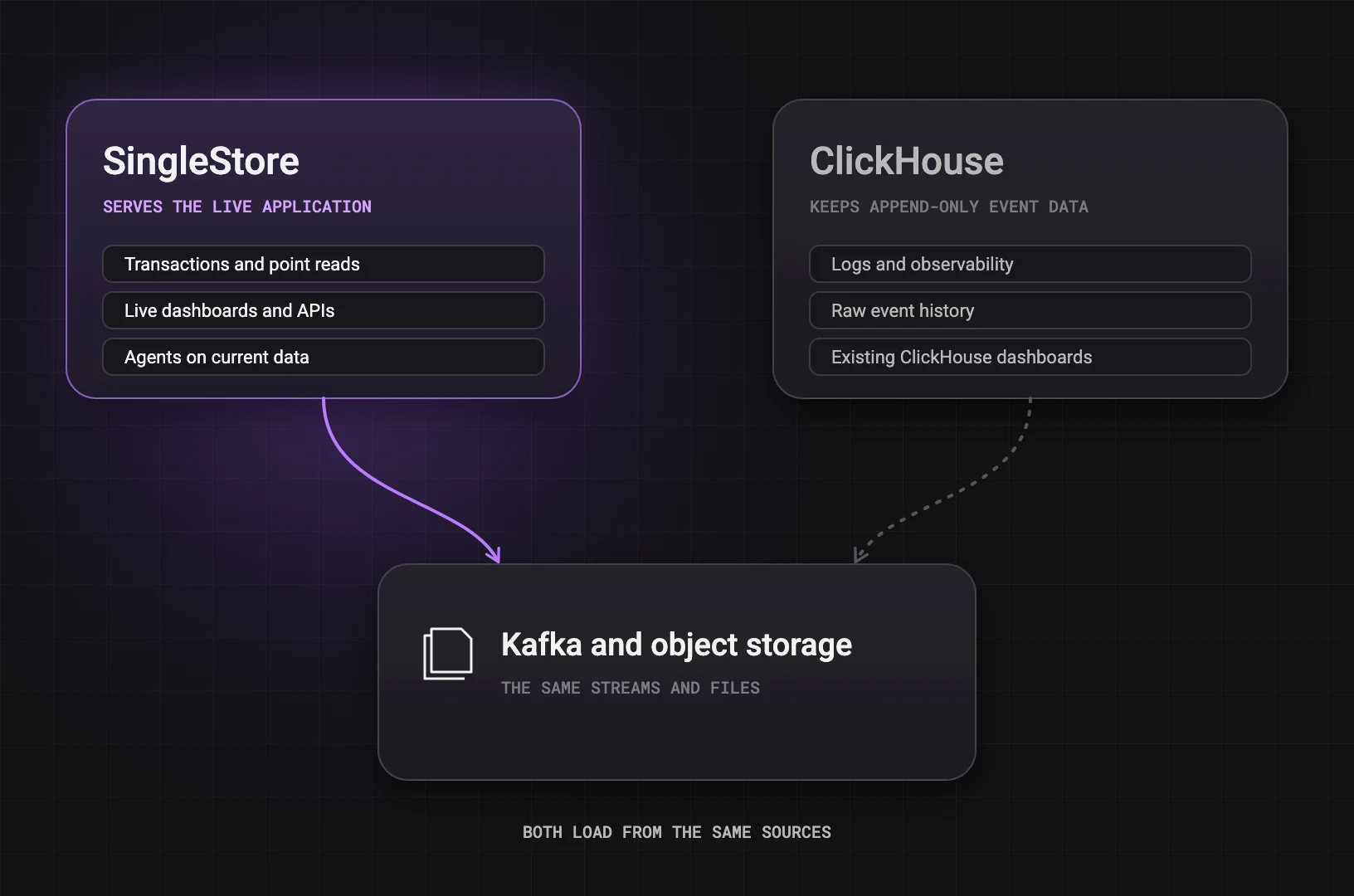
Many teams keep ClickHouse for logs, traces and raw event history, where data arrives in batches and rarely changes, and add SingleStore for the live application that needs updates, transactions and joins.
Both load from the same Kafka topics and object storage, so each system reads the data it needs without a pipeline between them.
For applications that update data, need transactions or join normalized tables, yes. For append-only logs and observability at very large scale, many teams keep ClickHouse and use SingleStore for the live application.
Yes. Standard UPDATE became generally available in ClickHouse 26.10, in October 2026. ClickHouse designs it for up to about 10% of a table, recommends batching, and it can’t change primary-key or partition-key columns.
Multi-statement transactions are experimental in open-source ClickHouse and not supported in ClickHouse Cloud. SingleStore runs ACID transactions with enforced keys.
In our May 2025 join benchmark on 1 TB of TPC-DS, SingleStore ran join-heavy queries faster, and ClickHouse has improved joins since. For single-table scans of event data, ClickHouse is very fast. The fair test is your own workload, so talk to an engineer about running it on both.
Yes. SingleStore Self-Managed runs in your own data center or cloud account. ClickHouse also runs on premises, as open source or as ClickHouse Private.
It reflects both products as of November 2026, when the latest ClickHouse release was 26.10, and each ClickHouse entry comes from ClickHouse’s documentation, listed under Sources at the end of this page. Check clickhouse.com for changes since then, and tell us if something here is out of date.
ClickHouse source documentation: clickhouse.com, ClickHouse documentation, joins best practices, UPDATE, ReplacingMergeTree, transactions, primary keys, insert strategy, async inserts, ClickPipes, concurrency FAQ, query cache, vector index, text index, remote MCP server, MySQL interface, PostgreSQL interface, Compute per compute-unit-hour, ClickHouse compliance, Private Link, public regions, ClickHouse Private.

Bring your hardest join or update workload.
See it run on SingleStore.
Talk to an engineer about your workload, or start free on a Shared cluster.