

SingleStore vs. Vertica
Vertica is a mature columnar database for large-scale analytics, now owned by Rocket Software. SingleStore is one distributed database for transactions, analytics and search, for analytics on data that streams in and changes all day.
Comparison as of November 2026, based on Vertica’s website and documentation.
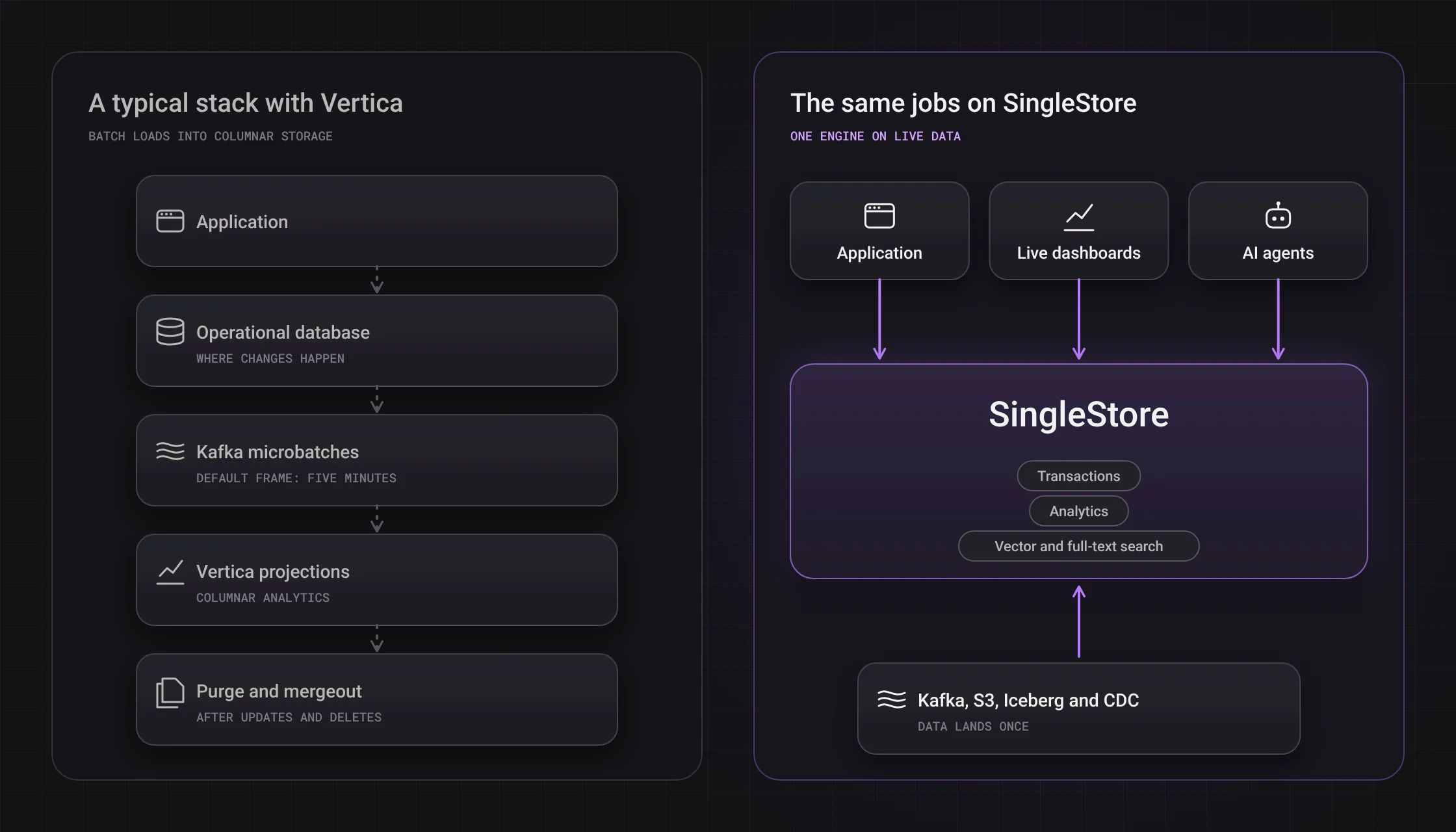
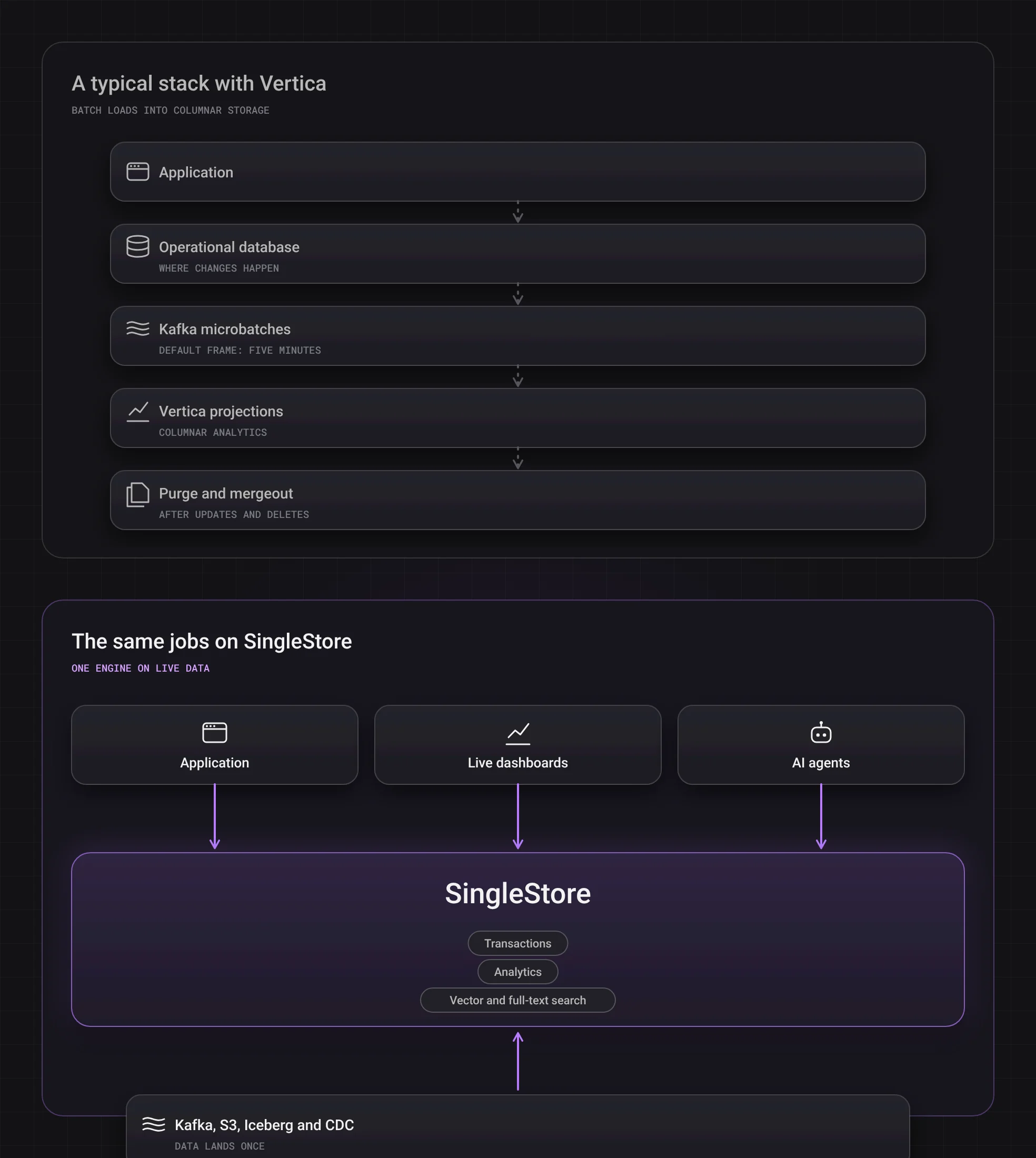
Vertica runs large analytical queries well on data loaded in batches. These are the points where analytics on streaming, changing data run into trouble.
Each Vertica entry comes from the Vertica documentation or Rocket Software’s and OpenText’s announcements, listed under Sources at the end of this page.
| Capability | SingleStore | Vertica |
|---|---|---|
Core design | One distributed SQL database for transactions, analytics and search, on one copy of the data. See SingleStore Helios. | A columnar MPP analytics database, now Rocket Vertica after Rocket Software bought it from OpenText in May 2026. Vertica 26.3 is the latest release. |
Architecture | Data and writes are distributed across the nodes of a cluster, with every table sharded automatically. | Enterprise mode on local disks, or Eon mode with communal object storage, a depot cache and subclusters. A long-standing strength. |
Transactions | ACID transactions with enforced primary and unique keys. See Universal Storage. | READ COMMITTED by default, with optional SERIALIZABLE isolation. |
Updates and deletes | Row-level updates and deletes while queries and loads continue. | Delete vectors and exclusive table locks for DELETE and UPDATE, with purges to reclaim space. |
Analytics | A columnstore with vectorized execution on the same tables as the transactions. See query performance. | Columnar storage with projections and in-database machine learning. A long-standing strength. |
Concurrency | Point reads, writes and analytical queries in the same engine, for thousands of concurrent users. | Resource pools budget memory and concurrency for each class of query. |
Loading and freshness | Pipelines load from Kafka, S3 and Apache Iceberg continuously, and a committed write is visible to the next query. | COPY loads straight to disk storage, and the Kafka scheduler defaults to five-minute frames. |
Vector and full-text search | Vector and full-text indexes on the same tables, combined with SQL filters in one query. See hybrid search. | Vector distance functions on array columns since 25.4, with no vector index, and text indexes for keyword search. |
SQL and drivers | ANSI SQL over the MySQL wire protocol, so SQL clients, BI tools and MySQL drivers connect directly. | Vertica SQL with JDBC, ODBC, ADO.NET, Python and Go clients, and a standalone MCP server since 26.3. |
Pricing model | Compute billed per hour by cluster size, from $0.99 an hour on Standard, plus storage. A free Shared cluster for development. See pricing. | Licensed by raw data size, by term or both, as BYOL, subscription or OEM. The Community Edition is no longer offered. |
Accurate at the time of publication, November 2026, when Vertica 26.3 was the latest release and Rocket Software had owned Vertica since May 2026. Confirm current capabilities, licensing and support with Rocket Software and in the Vertica documentation. Sources for each Vertica entry are listed at the end of this page. Spotted something out of date? Tell us.
Both run in an environment you control. SingleStore also runs as a managed service.
| Where it runs | SingleStore | Vertica |
|---|---|---|
Managed cloud service | SingleStore Helios® on AWS, Azure and Google Cloud. | Rocket Software lists BYOL and subscription deployments. This comparison found no current managed service. |
Your own data center | SingleStore Self-Managed, in single-node or multi-node clusters. | Self-managed on premises, in Enterprise or Eon mode. |
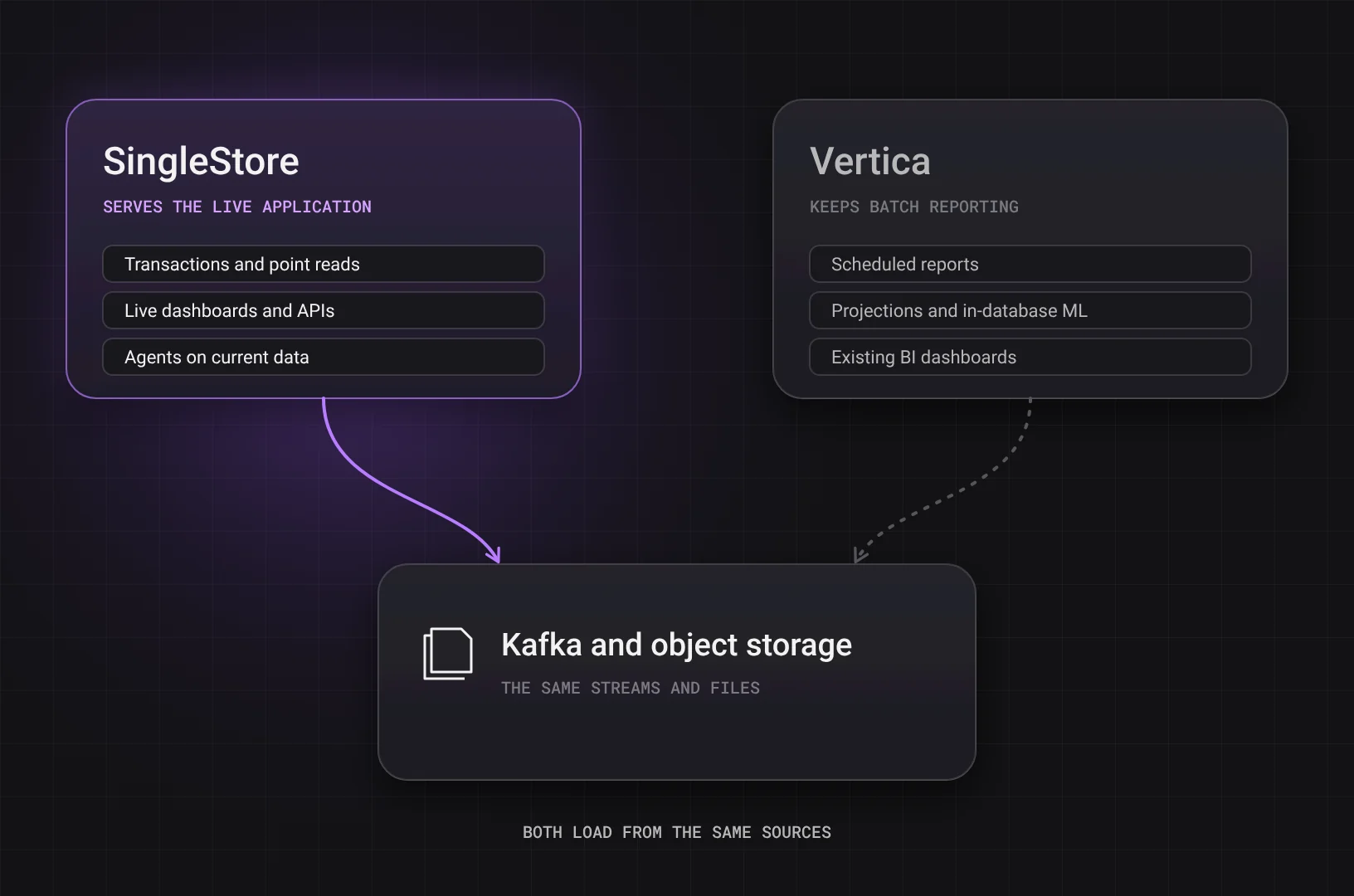
Many teams keep Vertica for scheduled reporting and in-database machine learning, and put new real-time dashboards and applications on SingleStore.
Both can load from the same Kafka topics and files. As more reporting moves to SingleStore, the batch jobs that feed Vertica can be retired one at a time.
Rocket Software completed its purchase of Vertica from OpenText on May 11, 2026, and sells it as Rocket Vertica. Releases continue, with 26.3 out and 26.4 planned as the next long-term support release. Check support terms and the roadmap with Rocket.
Most analytical SQL moves with changes. Vertica-specific features such as projections and some functions need rework, and SingleStore speaks the MySQL wire protocol, so drivers change. Our migration guide covers the planning.
Yes. Many teams keep Vertica for batch reporting and run real-time dashboards and applications on SingleStore, loaded from the same Kafka topics and files.
Partly. Vertica 25.4 added vector distance functions on array columns, without an approximate nearest-neighbor index. SingleStore has vector and full-text indexes on the same tables.
For batch scans of large tables, both are fast columnar databases. SingleStore is built for workloads that mix streaming loads, updates, point lookups and many concurrent users. The fair test is your own workload, so talk to an engineer about it.
It reflects both products as of November 2026, when Vertica 26.3 was the latest release. Check the Vertica documentation for changes since then, and tell us if something here is out of date.
Vertica source documentation: lists BYOL and subscription deployments, Vertica documentation, Delete vectors and exclusive table locks, Kafka frame duration, Vector distance functions, text indexes, Rocket Software acquisition, OpenText divestiture, Community Edition, Vertica 26.3, Enterprise or Eon mode, READ COMMITTED by default, Resource pools, MCP server, Licensed by raw data size.

Bring your slowest Vertica dashboard.
See it run on SingleStore.
Talk to an engineer about your workload, or start free on a Shared cluster.