Enterprise AI has promised faster decisions, smarter automation and better customer experiences, yet most organizations are still struggling to see real impact. Projects often begin with strong demos, but proof of concept stalls, pilots fail to scale and deployed systems frequently feel slow, fragile, or unreliable. The problem is not a lack of models, ambition, or even data. The problem is that enterprise AI systems often lack the context required to operate reliably once they leave the demo environment.

In consumer applications, AI can succeed with partial information. In the enterprise, that approach breaks down quickly. Business processes depend on accuracy, traceability and up-to-date information. When an AI system takes actions across multiple steps without access to the full business context behind those decisions, the results may sound plausible but fail under real-world conditions.
Why context matters more than the model
Context is everything a language model needs to produce a useful and correct response. In an enterprise setting, context includes transactional data, customer history, internal documents, logs, policies, permissions and the current state of workflows. Without this information, even the most advanced AI models are forced to guess. Guessing might be acceptable for creative tasks, but it is unacceptable for enterprise decision making.
This challenge becomes even more pronounced as organizations adopt smaller language models, or SLMs. SLMs are appealing because they are cheaper, faster and easier to deploy close to applications. However, they are also far more limited in memory and reasoning depth. They depend heavily on being given the right context for each decision. In practice, that context often lives across multiple systems: transactional databases, support platforms, operational logs and internal documents. If those sources cannot be accessed quickly and combined reliably, the model is forced to operate with an incomplete view of the business.
As an application moves through a workflow and calls the model repeatedly, each step depends on the system’s ability to retrieve the right context from across the business. When that context is incomplete, slow to assemble, or inconsistent across systems, the AI begins to behave unpredictably. As workflows grow more complex and more agents interact concurrently, those gaps compound and the system starts to drift away from the real state of the business.
A simple test exposes the issue quickly. If an AI system can produce an answer without referencing the current state of the business: customer history, policies, operational data, or workflow state, it is not making decisions. It is generating guesses.
The enterprise data gap
At the same time, enterprises are sitting on enormous amounts of untapped data. Gartner estimates that 70% to 90% of organizational data is unstructured, including documents, emails and multimedia files, and much of it effectively becomes dark data because it is difficult to govern, access, or incorporate into AI systems. When this information remains trapped in fragmented silos such as legacy databases, warehouses, object stores and external platforms, it becomes too slow or costly to retrieve in real time, and as a result it rarely makes its way into operational AI workflows.
This creates a fundamental paradox. Enterprises generate enormous volumes of valuable data, yet their AI systems operate with a narrow and outdated view of the business. SLMs, while efficient, are effectively blind without continuous access to fresh, relevant data. Without it, even capable models operate with an incomplete view of the business.
The real issue is not how much data an enterprise generates. It is how little of that data is actually available when the AI system makes a decision.
How enterprise AI systems operate across steps
To succeed, enterprise AI workflows must bring together context, applications and data in a continuous loop. The application orchestrates the workflow, calling a language model or a network of smaller models to decide what to do next. Beneath that workflow sits the enterprise data layer, which provides the current state of the business.
When an AI-driven application runs, it gathers the relevant context, sends a request to a model, and then takes the next step based on the response. What is often missing is the ability to attach the latest data and state before making the next request. Without this feedback loop, the application loses awareness of what just happened and why. Context fragments, and each step becomes less informed than the last.
The easiest way to evaluate an enterprise AI system is to watch what happens between steps in a workflow.
What makes a responsive context layer
A responsive context layer must meet several critical requirements. It must deliver low latency so applications can retrieve and update context in milliseconds. It must support high concurrency so thousands or millions of users and agents can access data simultaneously. It must also handle complex queries that combine structured data, semi structured data, unstructured text and vector embeddings.
As agentic AI applications become more common, concurrency will grow dramatically. Instead of one user interacting with one model, enterprises will run fleets of agents executing workflows on behalf of customers, employees and systems. If the context layer cannot keep up, the entire AI system slows down, regardless of how advanced the models are.
Building enterprise AI on a real time data foundation
This is where modern real time databases become essential. A database designed for real time workloads can act as both the system of record and the system of context for enterprise AI. This is the role that SingleStore was built to play.
SingleStore was designed from the ground up for low latency and high concurrency, enabling enterprises to query operational data, analytics data and vector data in a single system. This makes it possible to assemble rich context on demand for AI applications without moving data between slow silos.
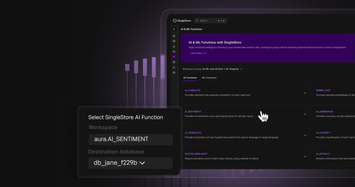
SingleStore also brings AI directly into the data layer through AI functions in SQL. Teams can perform text analysis, recommendations, segmentation and real time personalization directly where the data lives, keeping context tightly coupled with application logic. Features like zero copy attach enable instant and secure data sharing between systems without redundant duplication, making it easier to include more enterprise data in AI workflows.
Enterprise AI systems fail when they make decisions without access to the current state of the business. The models are rarely the limiting factor. The real constraint is whether the surrounding system can supply the right context, at the right time, every time a decision is made.