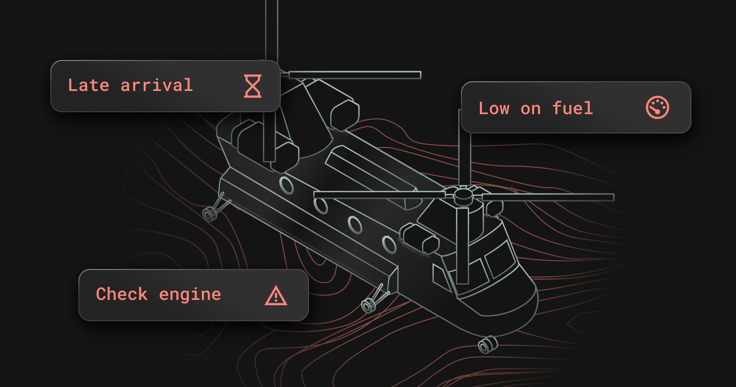
Anyone who has spent time around military operations knows that confidence in a decision rarely comes from how advanced the technology looks on paper. It comes from whether the information reflects what is actually happening across maintenance, logistics, personnel, and operational systems at the moment decisions are being made.
That is where many artificial intelligence (AI) initiatives in defense run into trouble.
The models themselves are improving quickly, and across the military departments, AI copilots are already supporting everyday tasks such as summarizing intelligence, drafting taskers, reviewing operational documents, and helping staff move through administrative workloads faster. In many offices, these tools are already part of the daily rhythm of work.
What limits their usefulness is not sophistication, but whether the data they rely on reflects current operational conditions across defense agencies and whether that data can be trusted across classified and distributed environments.
When it does not, automation can accelerate the wrong conclusions just as easily as the right ones.
Where AI Meets the Reality of Federal Government Defense Systems
Defense missions depend on an ecosystem of systems that were built at different times, for different purposes, and under very different security assumptions. Maintenance platforms, logistics networks, ERP systems, intelligence repositories, and personnel systems do not share a single operational view, and they often operate across NIPR, SIPR, JWICS, air-gapped environments, and tactical networks that cannot rely on continuous connectivity.
Most commercial AI architectures are designed around centralized data movement and periodic synchronization. Those patterns work in enterprise environments with stable connectivity, but they become fragile when data must move across classification boundaries, contested networks, or deployed edge systems operating under D-DIL conditions.
The effects are familiar to anyone working inside these environments. Events take time to surface. Different systems report different states of readiness. Access controls and data handling rules complicate integration. Accreditation cycles stretch as architectures become harder to explain and harder to govern.
Over time, operators and commanders learn to treat automated outputs as advisory rather than authoritative, which limits how far AI can move into operational workflows.
What This Looks Like in Day-to-Day Operations
Consider sortie generation and sustainment on an active flight line.
Sortie schedules are planned in advance, then adjusted continuously as aircraft health, parts availability, and crew assignments shift throughout the day. Maintenance issues do not arrive on a predictable cadence, and supply constraints rarely stay isolated to a single unit.
In many environments, those signals live in different systems that update on different timelines. Aircraft are scheduled based on assumptions that may already be outdated. Maintenance crews wait on parts that looked available earlier in the day. Readiness summaries reflect what was true hours ago rather than what is true now.
As a result, aircraft are pulled from the schedule late, maintenance plans are reshuffled, and commanders build buffers into operational plans because they know the data they are seeing may already be behind events.
When maintenance actions, sensor data, parts movement, and personnel status are reflected continuously in a shared operational view, the dynamics change. Problems surface earlier. Maintenance can be scheduled before delays cascade into the sortie window. Supply demand becomes more predictable. Units recover mission-capable aircraft sooner and with fewer last-minute disruptions.
In that setting, AI can support planning and prioritization in ways that align with how operations actually unfold, because it is working from data that reflects current conditions rather than delayed snapshots.
Why Governance and Performance Have to Travel Together
Defense organizations and federal agencies operate under constraints that leave little room for architectural shortcuts. Any AI system that influences operational decisions must respect classification markings, clearance levels, need-to-know rules, auditability requirements, and established command authorities.
When governance is layered on top of fragmented data pipelines, systems become harder to accredit and harder to operate. When performance degrades under load, operators bypass automation and fall back on manual coordination. When data lineage is unclear, oversight becomes a source of friction rather than confidence.
In practical terms, responsible AI in defense depends on governance and performance being enforced by the data architecture itself, not added later through policy controls and procedural checks.
Without that foundation, AI systems remain confined to narrow support roles, regardless of how capable the models may be.
How SingleStore Supports Operational AI
SingleStore supports AI and broader AI technology at the point where access to current, governed operational data becomes the limiting factor.
It is not intended to replace models, copilots, or governance tooling. Instead, it provides a real-time operational data platform that allows AI systems to reason over authoritative information without forcing that data through a chain of downstream systems.
In many defense architectures today, spanning military departments and defense agencies, operational data is pushed into a set of downstream platforms that each solve a specific part of the AI problem: analytics in one system, vector search in another, features or embeddings in a third, and reporting in yet another. Each platform has a defined role, but none of them can support an operational AI workflow on its own.
The challenge is not just that these systems sit downstream. It is that they are narrowly scoped. Each one introduces its own integration path, access controls, security configuration, and accreditation boundary, even though its contribution is partial. Data engineering teams end up managing and clearing multiple systems simply to assemble a working AI pipeline, rather than operating from a single operational view.
That fragmentation creates real overhead. Data has to be copied and reconciled across platforms, which, inherently, makes lineage harder to explain. During authorization and audit reviews, the burden shifts from demonstrating outcomes to explaining why so many systems are involved, all seeing slightly different versions of the same data. On the operational side, users learn to treat AI outputs cautiously, knowing they may be based on delayed or incomplete context.
SingleStore takes a more consolidated approach. Operational and analytical workloads run on the same authoritative data, which reduces the need to stand up and govern multiple niche platforms simply to support AI. Data movement is minimized, security boundaries are clearer, and accreditation paths are easier to manage because fewer systems are involved.
The main goal here is very practical: reduce unnecessary complexity, limit the number of systems that need to be secured and cleared, and give AI services across the armed forces and defense agencies access to a consistent operational picture. In defense environments, where complexity is already high and tolerance for inconsistency is low, that consolidation often makes the difference between AI that supports day-to-day operations and AI that remains confined to pilots and side workflows.
Lessons from Other High-Risk, High-Velocity Domains
Public defense programs do not always allow detailed technical deployments to be discussed openly, but the underlying architectural challenges are not unique to military environments.
Cybersecurity platforms operate on continuous streams of telemetry where delayed correlation means missed threats. Financial institutions operate under strict regulatory regimes where inconsistent data views create immediate operational and compliance risk.
In both domains, performance and consistency are inseparable. It is not enough for data to be fast; all consumers (automated systems, analysts, and decision-makers) must see the same version of the data at the same time. When data is copied across multiple platforms or synchronized on different schedules, operation teams end up acting on different truths, even when each system is technically “correct”.
SingleStore is used in production environments that require continuous ingestion, predictable low-latency queries under sustained load, strict access controls, and a single authoritative data foundation for both operational and analytical workloads. The result is not just faster systems, but tighter coordination: fewer reconciliations, less hesitation to act, and greater confidence that decisions are being made on current, consistent information.
These environments show that real-time, governed data platforms can deliver both speed and coherence under pressure. It’s an architectural pattern that maps directly to defense operations where decision advantage depends on everyone working from the same operational picture.
A More Realistic Path to AI Adoption in Defense
Programs that move beyond demonstrations and into sustained operational use tend to share several characteristics.
They begin with workflows that are structured and high-volume, such as maintenance triage, personnel actions, finance approvals, and tasker management, where process rules are clear and outcomes can be measured.
They define success in operational terms, including mission-capable rates, time to complete actions, supply responsiveness, and readiness reporting accuracy, rather than focusing solely on model performance metrics.
They involve operators, maintainers, and planners early in system design so that AI recommendations align with real decision rhythms and existing command structures.
They embed classification handling, access control, audit logging, and human-in-the-loop oversight directly into system architecture, which simplifies accreditation and builds confidence among users.
They design for enterprise and edge deployment from the outset, rather than treating tactical environments as a later extension of headquarters systems.
This approach treats AI as part of mission infrastructure rather than as a separate innovation program.
Readiness Ultimately Comes Down to Data and Time
The Department of Defense and the broader federal government are investing heavily in AI because decision cycles are accelerating and operational complexity continues to increase. AI can support that shift, but only when it operates on data that reflects current conditions and is governed in ways that commanders and oversight authorities can trust.
Architectures built around eventual correctness, delayed data movement and fragmented platforms are increasingly misaligned with how modern operations function. They slow response, complicate governance, and limit how deeply automation can be embedded into mission workflows.
Defense organizations that invest in real-time, unified data foundations position themselves to apply AI where it has the greatest operational impact: in planning, sustainment, and execution cycles where minutes and hours matter.
Those that do not will continue to validate promising AI models while discovering that the surrounding infrastructure cannot support them when operational pressure is highest.
In defense, that difference shows up in tempo, resilience, and ultimately in decision advantage.