

SingleStore vs. Snowflake
Snowflake is a cloud data platform built around a warehouse for analytics at scale. SingleStore is one database for transactions, analytics and search on live data, and it runs in the cloud or in an environment you control.
Comparison as of November 2026, based on Snowflake’s website and documentation.
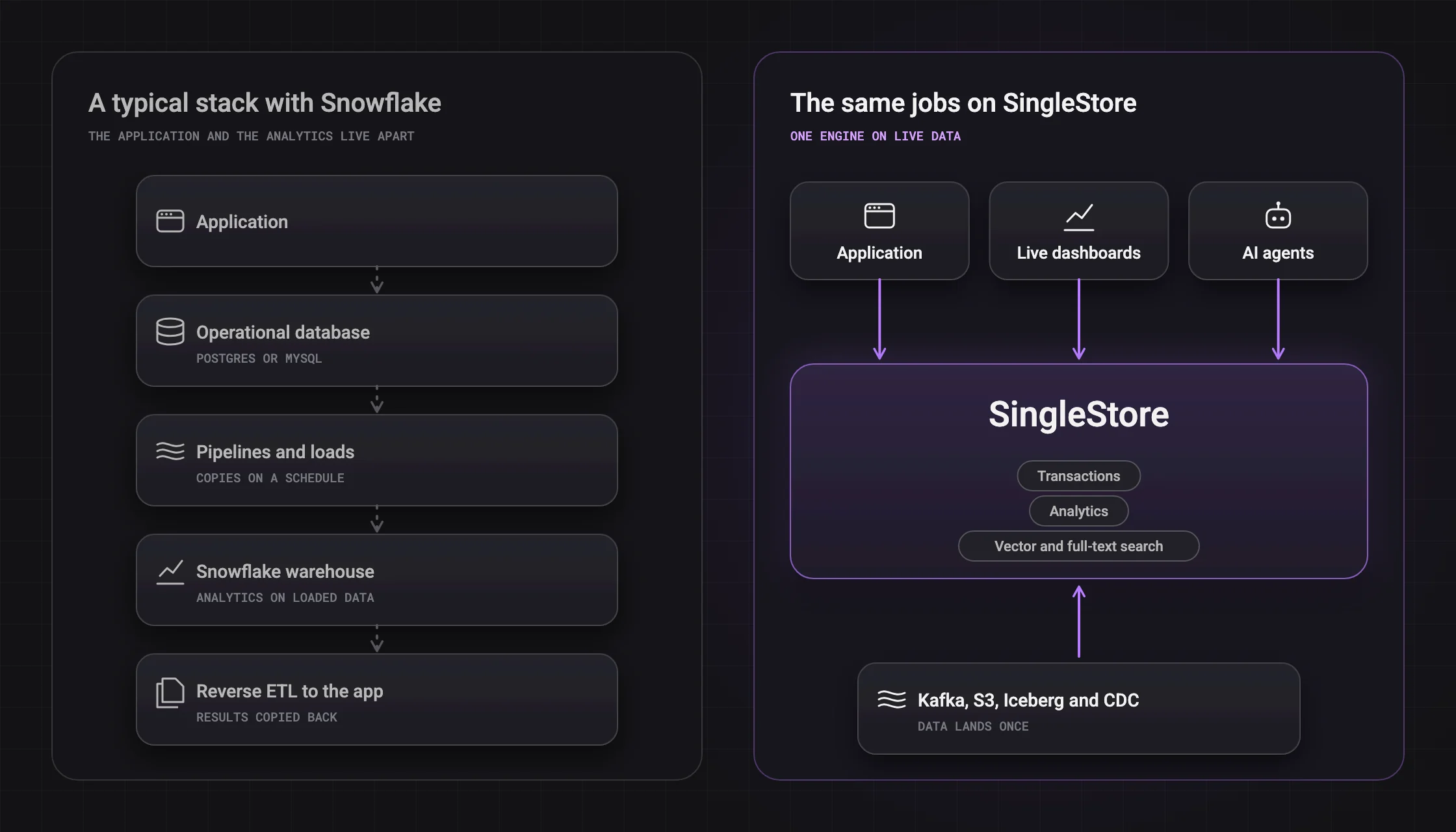
Snowflake is built for analytics on loaded data, and it does that well. These are the points where teams asking it to serve live applications and AI agents run into trouble.
Each Snowflake entry comes from Snowflake’s own documentation, listed under Sources at the end of this page.
| Capability | SingleStore | Snowflake |
|---|---|---|
Core design | One distributed SQL database for transactions, analytics and search, on one copy of the data. See SingleStore Helios. | A cloud data platform built around a columnar warehouse, with separate table types and services for other workloads. |
Transactions | ACID transactions on standard tables, readable as soon as they commit. See Universal Storage. | Hybrid tables add row storage, indexes and enforced keys: GA on AWS and Azure, preview on Google Cloud, with limits of 2 TB of hybrid storage and about 16,000 operations per second per database. Snowflake Postgres runs separate managed Postgres instances on AWS and Azure. |
Data freshness | Rows are queryable when they commit. SingleStore Pipelines load from Kafka, S3 and Iceberg, with change data capture from MySQL and MongoDB®. | Snowpipe Streaming makes data queryable in as little as 5 seconds. Dynamic tables have a minimum target lag of 60 seconds. |
Low-latency serving | Point reads and analytical queries in the same engine, with single-digit millisecond responses on operational data, for thousands of concurrent users. See query performance. | Interactive warehouses target sub-second responses for dashboards and APIs. Queries time out after 5 seconds, billing has a 1-hour minimum, and interactive tables refresh at most every 60 seconds. |
Vector and full-text search | Vector and full-text indexes on the same tables, combined with SQL filters in one query. See hybrid search and the built-in vector database. | A VECTOR data type up to 4,096 dimensions, the SEARCH function for full text, and Cortex Search, a managed hybrid search service. |
AI and agents | Agentic Intelligence: Aura Analyst for plain-English questions, AI Functions in SQL and the SingleStore MCP server for agents. | Cortex AI Functions, Cortex Agents, Snowflake CoWork (formerly Snowflake Intelligence) and a managed MCP server. |
Open table formats | Loads from and writes back to Apache Iceberg tables. See Iceberg with Snowflake and SingleStore. | Iceberg tables with full read and write for Snowflake-managed tables. External engines read and write through the Horizon Iceberg REST catalog. |
SQL and drivers | ANSI SQL, compatible with the MySQL wire protocol, so MySQL drivers and tools connect. | Snowflake SQL through Snowflake’s own drivers. Postgres clients connect only to Snowflake Postgres instances. |
Pricing model | Compute billed per hour by cluster size, from $0.99 an hour on Standard, plus storage. A free Shared cluster for development. See pricing. | Compute credits billed per second with a 60-second minimum, plus storage and separately billed serverless features, across four editions. |
Certifications | ISO 27001 and SOC 2 Type 2. See the Security and Trust Center. | A longer list, including SOC 2 Type II, ISO 27001, PCI DSS, HITRUST, FedRAMP High and DoD IL5. See Snowflake compliance. |
Private connectivity | Private connections over AWS PrivateLink, Azure Private Link and Google Private Service Connect. | Private connectivity over the same three services, on Business Critical edition or higher. |
Accurate at the time of publication, November 2026. Snowflake updates its products often, so confirm current capabilities, availability and pricing on snowflake.com and in the Snowflake documentation. Sources for each Snowflake entry are listed at the end of this page. Spotted something out of date? Tell us.
Snowflake runs only as a managed service. SingleStore runs as a managed service or in an environment your team controls.
| Where it runs | SingleStore | Snowflake |
|---|---|---|
Managed cloud service | SingleStore Helios® on AWS, Azure and Google Cloud. | On AWS, Azure and Google Cloud, in about 50 commercial regions. |
Your own data center | SingleStore Self-Managed, in single-node or multi-node clusters. | Not offered. Virtual Private Snowflake is a dedicated environment that Snowflake runs. |

Mauricio Aristizabal
Principal Data Architect, impact.com

We looked at four players: BigQuery, Cloudera CDP (Impala/Kudu), SingleStore, and Snowflake. Several of the competitors have good features, but they all had a pitfall or two that held us back. Whereas SingleStore really ticked all the boxes.
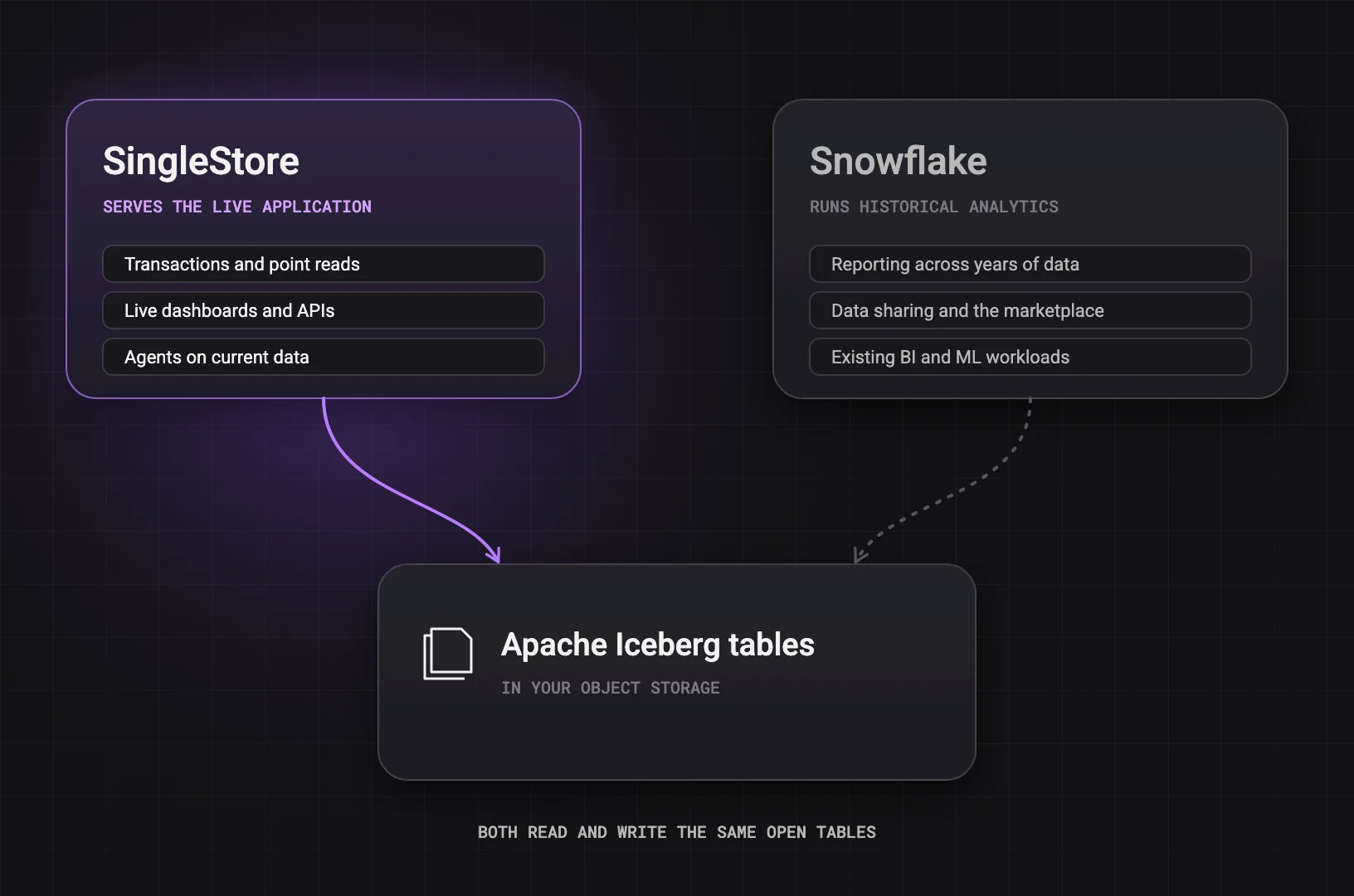
Many teams keep Snowflake for reporting and data science across their history, and add SingleStore for the live application: the dashboards, APIs and agents in their product that need the latest data.
SingleStore loads from and writes back to Apache Iceberg tables, and Snowflake reads and writes Iceberg tables too. The two can work from the same open tables in your object storage, with no extra pipeline between them.
It depends on the workload. SingleStore replaces the operational database, pipelines and serving layer an application needs around a warehouse, and many teams keep Snowflake for historical analytics alongside it.
Yes, within limits. Hybrid tables add row storage and enforced keys, GA on AWS and Azure, with limits of 2 TB of hybrid storage and about 16,000 operations per second per database. Snowflake Postgres runs managed Postgres instances beside the warehouse. SingleStore runs transactions and analytics on the same tables in one engine.
For queries that need the latest data at high concurrency, such as dashboards inside a product, SingleStore answers in milliseconds on data that just changed. For large scans over loaded history, the fair test is your own query, so talk to an engineer about running it on both.
Yes. SingleStore Self-Managed runs in your own data center or cloud account. Snowflake is offered only as a managed cloud service.
Yes, through Apache Iceberg. SingleStore loads from and writes back to Iceberg tables, and Snowflake reads and writes Iceberg tables too.
It reflects both products as of November 2026, and each Snowflake entry comes from Snowflake’s documentation, listed under Sources at the end of this page. Check snowflake.com for changes since then, and tell us if something here is out of date.
Snowflake source documentation: snowflake.com, Snowflake documentation, concurrency level and queuing, multi-cluster warehouses, Snowpipe Streaming, dynamic tables, Interactive warehouses, hybrid table limits, Snowflake’s compliance list, Hybrid tables, Snowflake Postgres, VECTOR data type, SEARCH function, Cortex Search, Cortex AI Functions, Cortex Agents, managed MCP server, reads and writes Iceberg tables, Snowflake’s own drivers, credits billed per second, Virtual Private Snowflake, Private connectivity, commercial regions.

Bring your slowest Snowflake query.
See it run on SingleStore.
Talk to an engineer about your workload, or start free on a Shared cluster.