Migrate from MySQL
to SingleStore in Minutes
Modernize your legacy, single-node database.
If you're running into performance bottlenecks, scalability challenges or the inability to handle modern, real-time analytics workloads with MySQL, it's time to consider SingleStore.
SingleStore’s unified database combines the best of traditional transactional (OLTP) databases with modern analytics (OLAP) capabilities, making it the ideal choice for businesses looking to modernize their data infrastructure.
Performance at scale
MySQL’s InnoDB (the default engine) uses row-level locking, which generally improves concurrency but encounters DEADLOCK or lock contention under heavy workloads.SingleStore’s distributed architecture delivers high-performance SQL analytics on large datasets, enabling sub-second query times — even at scale.
Unified workloads
SingleStore supports Hybrid Transactional/Analytical Processing (HTAP), allowing you to run transactional and analytical workloads on the same data — no need for unnecessary data movement or complex ETL pipelines
Real-time analytics
Where MySQL requires additional tools for real-time analytics, SingleStore offers native real-time capabilities, ensuring low-latency insights for time-sensitive applications.
Built for modern applications
While MySQL may not natively support advanced geospatial features, built-in machine learning, or vector data types for AI, SingleStore provides powerful JSON and geospatial functionality, robust machine learning integration support for vector data types and seamless data streaming. These capabilities empower developers to build truly intelligent, data-driven applications.
Scalability without limits
MySQL’s core scalability option Replication (master → replica) is complex and tricky to manage for automatic failover, data consistency and ensuring up-to-date replicas. SingleStore’s distributed design allows for seamless horizontal scaling — without manual intervention.
Schema changes and migrations
Altering large tables or adding/dropping columns can lock tables and disrupt production traffic. Frequent schema changes, which are common in agile development, can lead to downtime or degraded performance. SingleStore schema changes operations are online and can be achieved even in production workloads.
Backup and restore
As data sets grow, MySQL’s backup/restore times (especially logical) can become an operational challenge. SingleStore offers a more distributed, parallel backup/restore workflow, significantly reducing downtime and time-to-recovery for large-scale, high-throughput environments.

MySQL vs. SingleStore
MySQL has hidden costs and performance downfalls. Modernize and scale your tech stack with SingleStore for faster analytics at a fraction of the total spend.
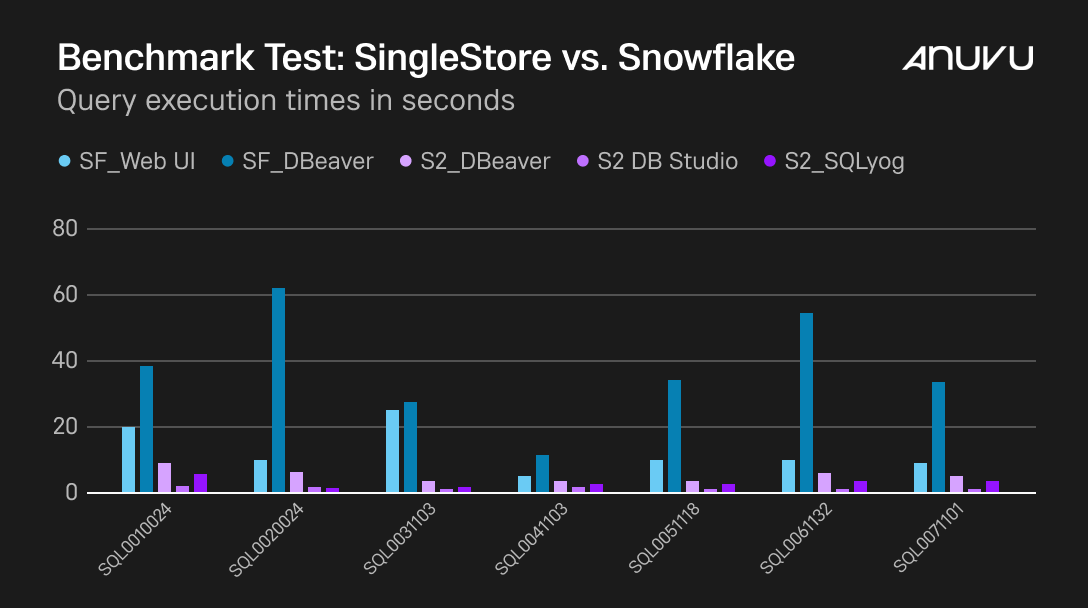
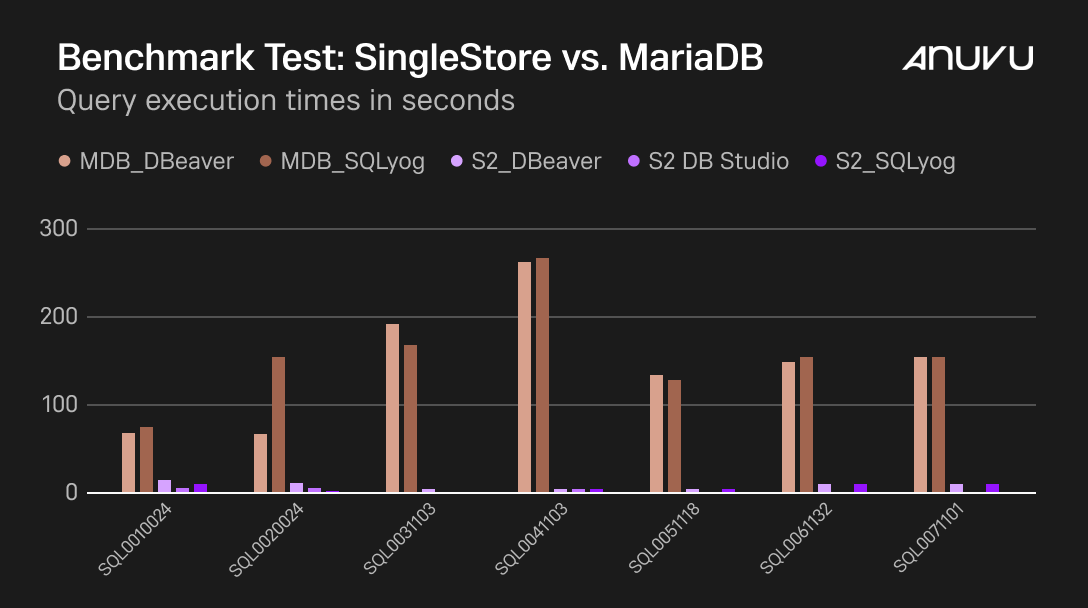
Faster analytical queries from a distributed columnstore.
70% reduction in infrastructure costs by consolidating databases and simplifying data pipelines.
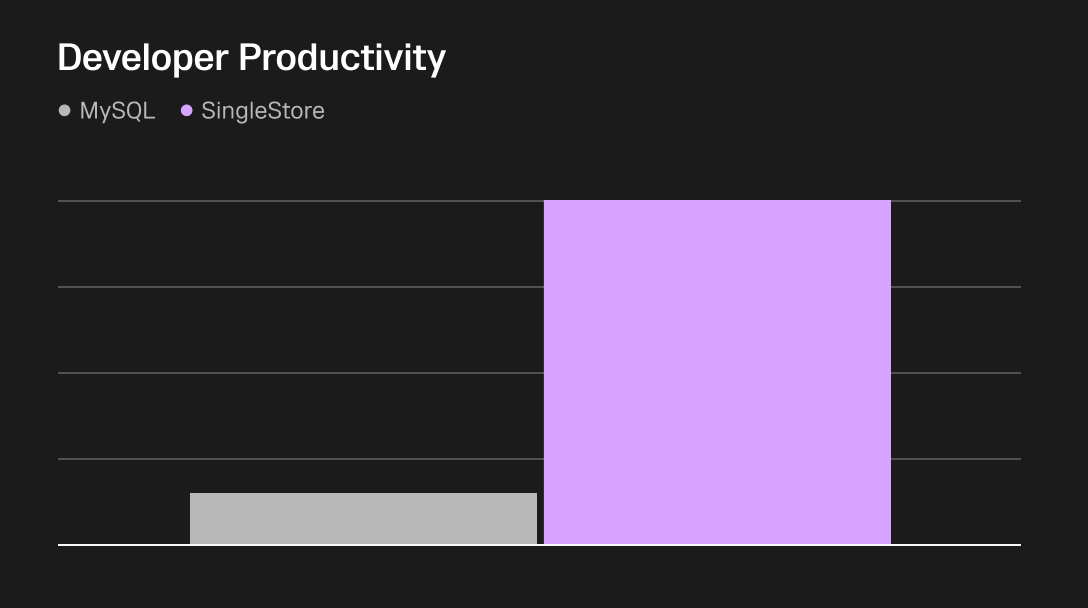
Improved developer productivity, thanks to a unified platform that eliminates the need for multiple database systems.
In-memory processing
Accelerates query execution with in-memory storage options.
High availability
Built-in redundancy and failover mechanisms ensure reliability.
Multi-cloud support
Deploy on AWS, Azure, GCP, or on-premises.
Seamless integration
Native connectors for popular tools and frameworks like Kafka, Spark and TensorFlow.

"With SingleStore we've achieved 24x faster response times and a 75% reduction in total cost of ownership."

"We considered MariaDB and NoSQL databases, as well as Oracle Database in-memory. What we wanted was a relational database that had the speed of NoSQL. We chose SingleStore."

"I don’t think this business unit is viable for us without SingleStore. We couldn’t hit the performance requirements with MySQL."
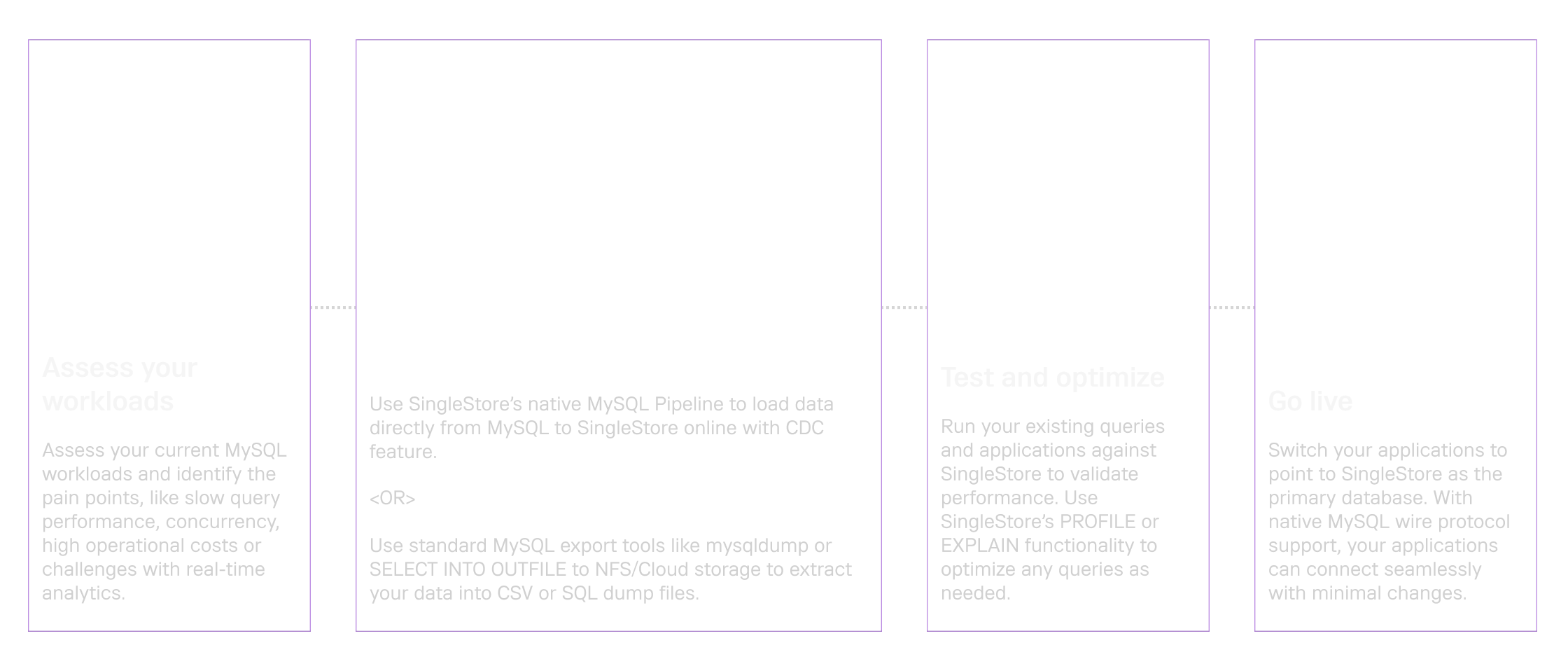
How to migrate from MySQL® to SingleStore
MySQL RDS Data Integration Into SingleStore
MySQL vs. SingleStore comparison
5 Steps to Migrate From MySQL to SingleStore

How Adobe hit 300x faster query performance with SingleStore

Choosing your next database

MySQL OPTIMIZE TABLE: How to Keep Your Database Running Smoothly
How to Fix MySQL Error 1040: Too Many Connections

MySQL Error 2002 (hy000): can’t connect to local MySQL server through socket