Retrieval-Augmented Generation (RAG) has become a cornerstone technique for grounding language models in external knowledge. Traditional RAG pipelines rely on vector search to pull relevant text chunks and then feed those chunks to an LLM to generate answers. GraphRAG takes this a step further by extracting entities and relationships, building an explicit knowledge graph, and using graph-aware retrieval to support multi-hop reasoning and richer, more faithful responses.
Today, we will understand how RAG works and why GraphRAG easily takes over naive RAG.
Large language models (LLMs) usually hallucinate, as in, sometimes they come up with their own unverified responses, fake responses, made up answers, etc and this is a serious problem.
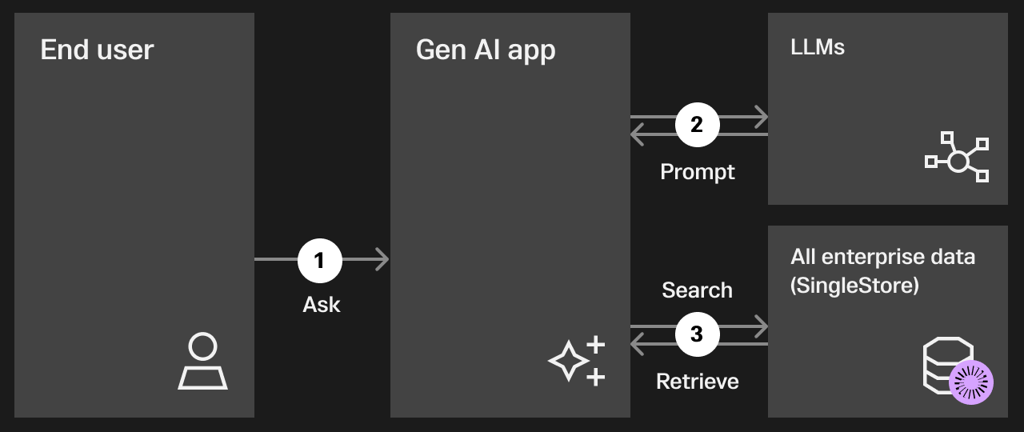
These models aren’t useful if we directly use them in our AI applications. To make sure our AI apps perform well and retrieve contextually relevant information/responses, we need some techniques to mitigate the LLM hallucinations. The major techniques involve prompt engineering, fine-tuning and retrieval augmented generation (RAG), of which, RAG is considered the best option so far. In RAG, we augment our custom data through a database (we often call it a vector database), so our LLM can usually search relevant chunks by going through the database and hence provisioning contextually relevant responses. There can be many techniques to enhance the RAG approach but will not dwell into that as of now.
Further, let’s understand both traditional and GraphRAG approaches.
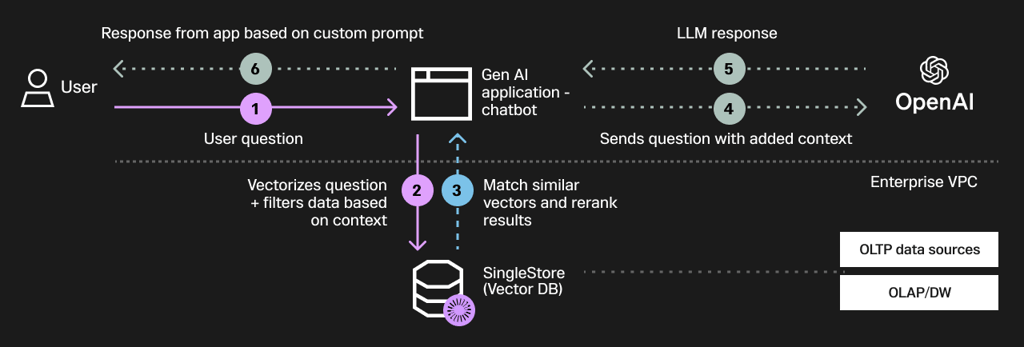
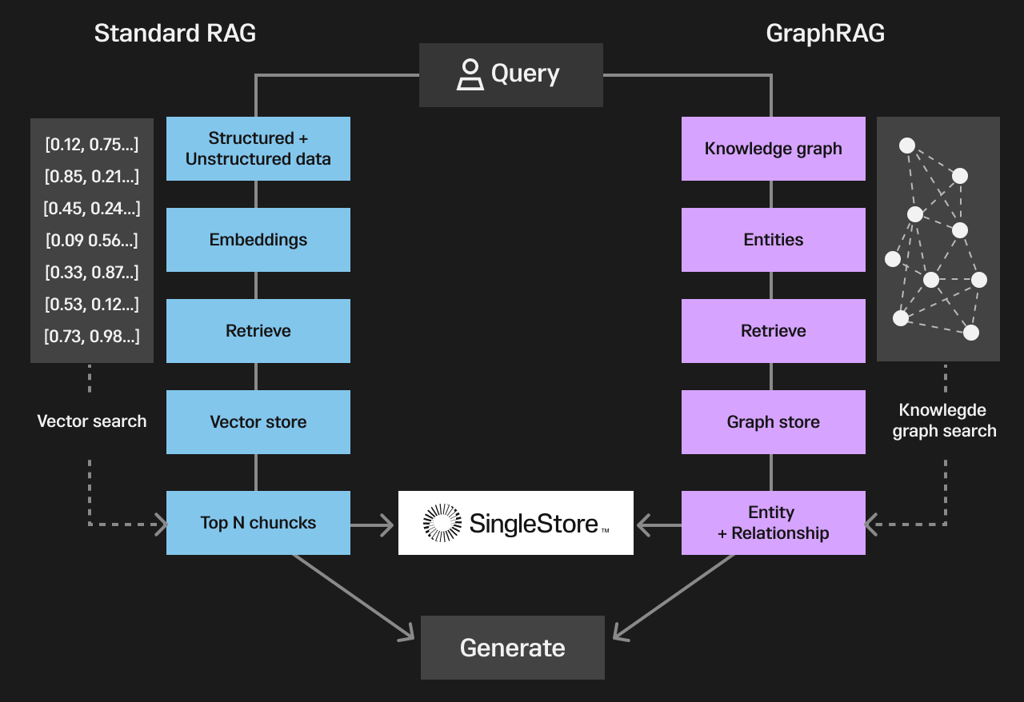
Traditional RAG uses vector embeddings and similarity search to retrieve the most relevant text chunks. In this approach, documents are split into smaller segments, converted into high-dimensional vectors through embedding models, and stored in vector databases. When a query arrives, it's similarly embedded and compared against the stored vectors using similarity metrics like cosine similarity. The system retrieves the top-k most similar chunks based on semantic proximity to the query. These retrieved passages are then injected into the LLM's context window as additional information. While effective for straightforward fact retrieval and question-answering tasks, traditional RAG can struggle with queries requiring multi-hop reasoning, understanding complex relationships between entities, or synthesizing information scattered across multiple document sections.
The classic RAG pipeline is simple, elegant, and often effective. Here are the essential steps:
- Ingest documents and split them into chunks (tokenization and chunking).
- Convert each chunk into a vector embedding using an embedding model.
- Store embeddings in a vector store or vector database.
- On a user query, embed the query and perform a vector search to fetch the top-k chunks.
- Pass retrieved chunks to an LLM that conditions on them to generate the final answer.
This approach makes RAG easy to scale and fast to implement. Vector search excels at retrieving text that is semantically similar to a query, which often yields high-quality answers for straightforward information needs.
Despite its strengths, traditional RAG has limitations:
- Weak multi-hop reasoning: Vector search retrieves chunks that are individually relevant, but it does not explicitly capture how pieces of information connect across chunks.
- Poor entity disambiguation: If a query requires understanding specific entities and their relationships, simple similarity search can miss the needed links.
- Higher hallucination risk: LLMs may combine retrieved snippets incorrectly when the graph structure linking facts is absent.
- Limited provenance: It is harder to trace how a final answer was assembled from multiple connected facts.
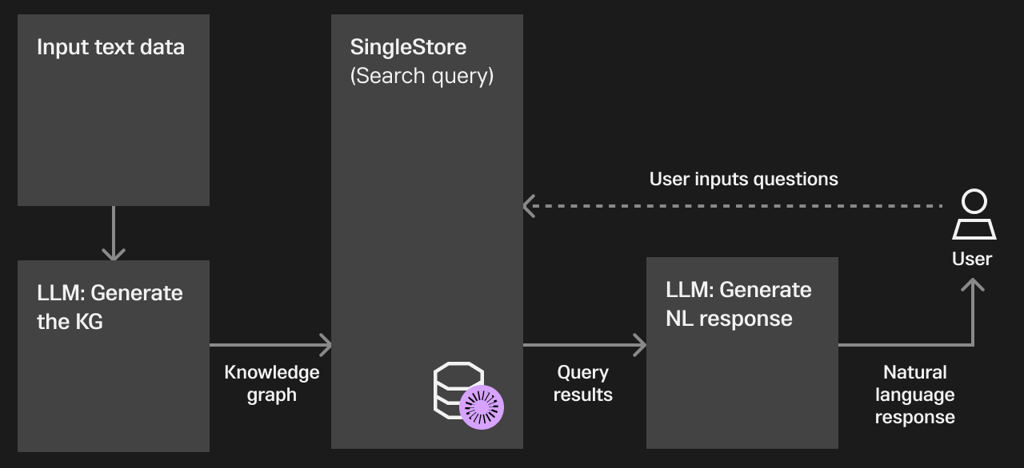
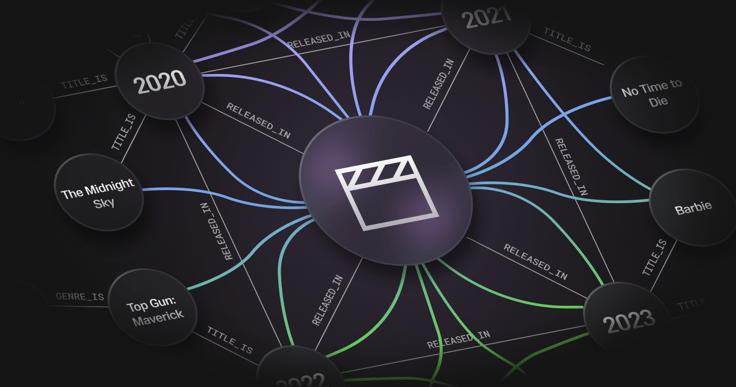
GraphRAG transforms documents into entities and relationships, stores them as a knowledge graph, and performs graph-aware retrieval that can traverse connections between entities. This approach begins by extracting structured information from unstructured text—identifying entities (people, places, concepts) and the relationships connecting them. These elements form nodes and edges in a knowledge graph, enabling the system to understand how information interconnects. During retrieval, GraphRAG can perform sophisticated operations like multi-hop traversal, relationship filtering, and community detection to gather contextually rich information. This structural understanding allows GraphRAG to excel at complex queries requiring reasoning across multiple related facts, discovering implicit connections, and providing more comprehensive answers that consider the broader context and interdependencies within the knowledge base.
- Chunk the source text and run entity extraction and relation extraction on each chunk.
- Create graph nodes for entities (people, organizations, dates, products, concepts).
- Create edges that represent explicit relationships (acted_in, directed_by, born_on).
- Attach textual chunks or pointers to nodes/edges so you can retrieve both structured relations and the original text evidence.
- On a query, perform graph-aware retrieval: identify entities mentioned in the query, traverse the graph for connected evidence, and collect the most relevant node/edge-backed chunks.
- Pass this structured, multi-hop evidence to the LLM to generate an answer.
GraphRAG brings three key advantages to RAG workflows:
- Explicit multi-hop paths: When a question requires chaining facts—"Who directed the movie where Actor X played character Y?"—a graph traversal can follow the path (actor → character → movie → director) explicitly, avoiding blind similarity matching.
- Better entity grounding: The graph represents entities distinctly (e.g., multiple people named "Alex") and connects them to unique identifiers and context, reducing ambiguity.
- Stronger provenance and traceability: Each answer can be traced back to specific nodes, edges, and text chunks, which improves faithfulness and interpretability.
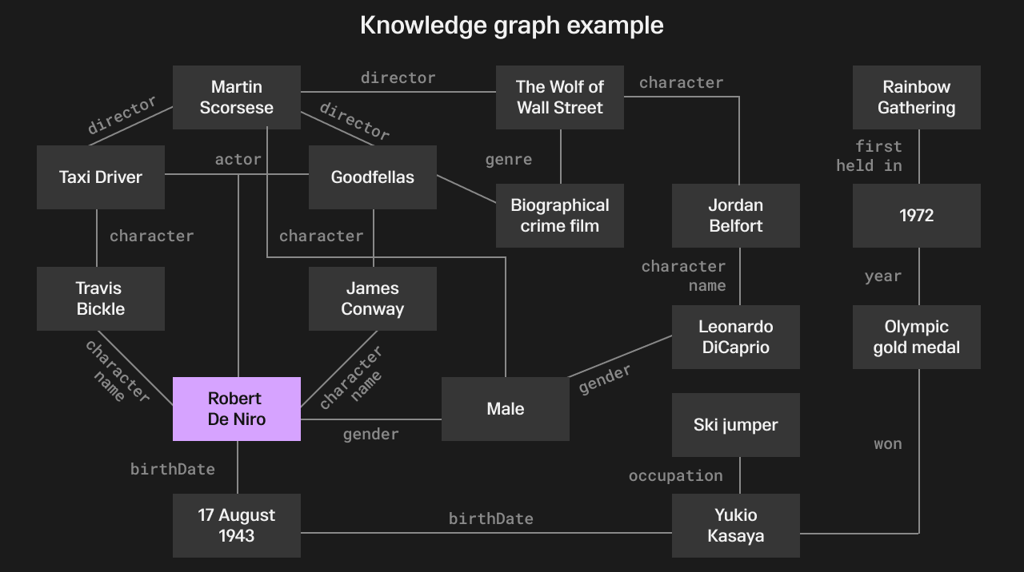
Imagine building a small knowledge graph for actors and films. Nodes represent people and films; edges represent relationships like acted_in and directed_by. A fragment of that graph might look like:
Node: Robert De Niro
Edge: acted_in → Taxi Driver (character: Travis Bickle)
Edge: acted_in → Goodfellas (character: Jimmy Conway)
Node: Martin Scorsese
Edge: directed_by → Goodfellas (director: Martin Scorsese)
When you ask a question that spans several relationships—"Which director worked with Robert De Niro on Goodfellas?"—graph traversal returns an exact path and the evidence chunk. The LLM receives structured evidence, reducing guesswork and enabling more accurate multi-step reasoning.
A practical architecture can use one unified database to store both vector embeddings and graph data. That simplifies deployment and avoids synchronization headaches between separate systems.
- Document ingestion module: Reads PDFs or other documents, splits them into chunks, and generates embeddings for each chunk.
- Entity and relation extraction module: Runs an LLM or an NLP pipeline to extract entities and relations from each chunk and outputs graph nodes and edges.
- Unified database: Stores vector embeddings in a table for traditional RAG and stores nodes, edges, and node-to-chunk mappings in tables for GraphRAG.
- Retrieval engine: Implements both vector search and graph search. The engine can execute both pipelines in parallel for comparison.
- LLM judge: An LLM-based evaluator that scores and compares answers across metrics like relevance, faithfulness, completeness, and reasoning.
- User interface: A simple interface lets you query the system, show retrieval evidence, and compare the outputs from traditional RAG and GraphRAG side-by-side.
Using a single database that supports both vector and graph primitives reduces operational complexity. You avoid syncing two stores and get a simpler developer experience. It also makes it easy to inspect both the vector table (embeddings and chunks) and the graph tables (nodes, edges, node-chunk links) for debugging and analysis.
SingleStore is particularly well-suited for this unified approach. As a distributed SQL database with native support for both vector search and graph operations, SingleStore eliminates the need for maintaining separate infrastructure. Its columnar storage engine efficiently handles high-dimensional vectors while simultaneously supporting graph traversal queries through SQL extensions. SingleStore's in-memory rowstore and disk-based columnstore architecture provide the performance needed for real-time similarity searches and complex graph queries.
Additionally, SingleStore's ACID compliance ensures data consistency across both vector and graph operations, while its horizontal scalability allows you to handle growing knowledge bases without architectural changes. The ability to perform joins between vector similarity results and graph traversals in a single query significantly simplifies application logic and reduces latency compared to orchestrating multiple databases.
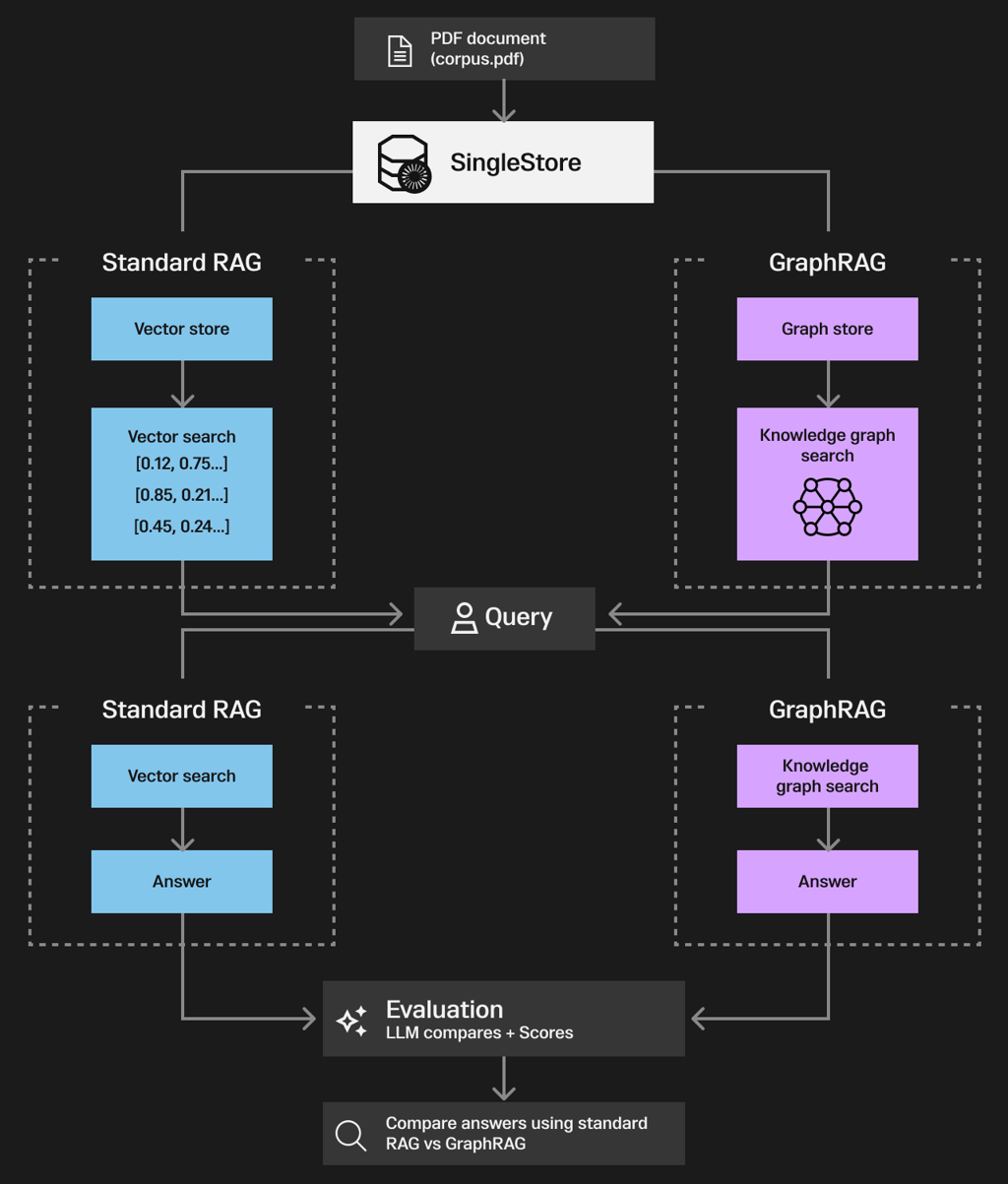
You can evaluate both approaches by feeding the same corpus into two parallel pipelines:
Traditional RAG: chunk → embed → store → vector-retrieve → LLM
GraphRAG: chunk → extract entities/relations → build graph → graph-retrieve → LLM
After both produce answers, an LLM judge evaluates them on defined metrics:
- Relevance: Does the answer address the question?
- Faithfulness: Are claims supported by the retrieved evidence?
- Completeness: Does the answer cover necessary aspects and edge cases?
Reasoning: Does the answer demonstrate correct logical steps and multi-hop inference?
In many demonstrations, GraphRAG wins on completeness and reasoning because it surfaces connected facts and explicit chains of evidence. The judge can return both qualitative feedback and numeric scores for each metric, enabling quantitative comparison between the two RAG variants.
A straightforward reproduction uses:
- A single PDF research paper as the knowledge source.
- A unified database SingleStore for embeddings and graph structures.
- A small UI to ask questions and visualize retrieved chunks, graph nodes, and edges.
- Create or sign up for the SingleStore database instance that supports both vectors and graph-like tables.
- Provide the database connection details (host, port, username, password, database name).
- Ingest the PDF: split text into chunks, generate embeddings, and store them in the vector table.
- Run entity and relation extraction across chunks and populate the graph tables: nodes, edges, and node-chunk links.
- Start the app and issue a question. The system executes both the traditional RAG and GraphRAG pipelines in parallel and shows both results, retrieved evidence, and the LLM judge's evaluation.
In a representative run, asking a question about how recursion improves reasoning in language models produced two answers. The LLM judge evaluated both responses and scored GraphRAG higher for completeness and reasoning because it could reference multi-hop conclusions and empirical results cited across connected chunks.
This is the complete repository with all the code you can follow: https://github.com/pavanbelagatti/TraditionalRAG-Vs-GraphRAG
- The task is largely single-hop retrieval: short fact lookup, FAQ answering, or document summarization of local context.
- Latency and simplicity are the top priorities.
- You have a relatively small, flat corpus that does not require complex entity linking.
- The queries require chaining multiple facts across documents or sections.
- Entity disambiguation and provenance are important.
- Explainability and traceable reasoning paths are required (legal, medical, or scientific workflows).
GraphRAG is powerful, but not a silver bullet. Consider these tradeoffs:
- Graph extraction quality: The graph is only as good as the entity and relation extraction model. Errors in node or edge creation produce incorrect paths.
- Indexing cost: Building and maintaining a graph requires extra preprocessing and storage compared to simple embeddings.
- Complexity: Graph traversal logic and ranking connected evidence add implementation complexity.
- Scalability: Large graphs require careful design to ensure fast traversals and efficient retrieval at scale.
- Use robust named-entity recognition and relation extraction models. Combine heuristic rules with ML for better recall and precision.
- Store both the structured graph and the raw text chunk references. Graph nodes should point back to original evidence for verifiability.
- Rank graph paths by a combination of path relevance score and textual evidence quality before passing to the LLM.
- Use an LLM judge or human evaluation to calibrate which retrieval heuristics produce the best downstream answers.
- Keep the graph schema flexible: different domains require different entity and relation types.
RAG is a foundational technique for grounding large language models. Traditional RAG is fast and simple, but GraphRAG unlocks richer reasoning by explicitly modeling entities and relationships. When the problem demands multi-hop inference, interpretability, and precise provenance, GraphRAG is the stronger approach.
Building a practical GraphRAG system can be straightforward: ingest documents, extract entities/relations, store both embeddings and graph data in a unified backend, and evaluate outputs using an LLM judge. This pattern yields answers that are not only relevant but also verifiable and logically consistent.
Experimentation is key. Try running both approaches side-by-side on your domain corpus and measure relevance, faithfulness, completeness, and reasoning. In many cases, GraphRAG will provide more comprehensive and defensible answers—exactly what you need when correctness matters.